




How to Automate Supply Chain Risk Reports: A Guide for Developers
Do you use Python? If so, this guide will help you automate supply chain risk reports using AI Chat GPT and our News API.

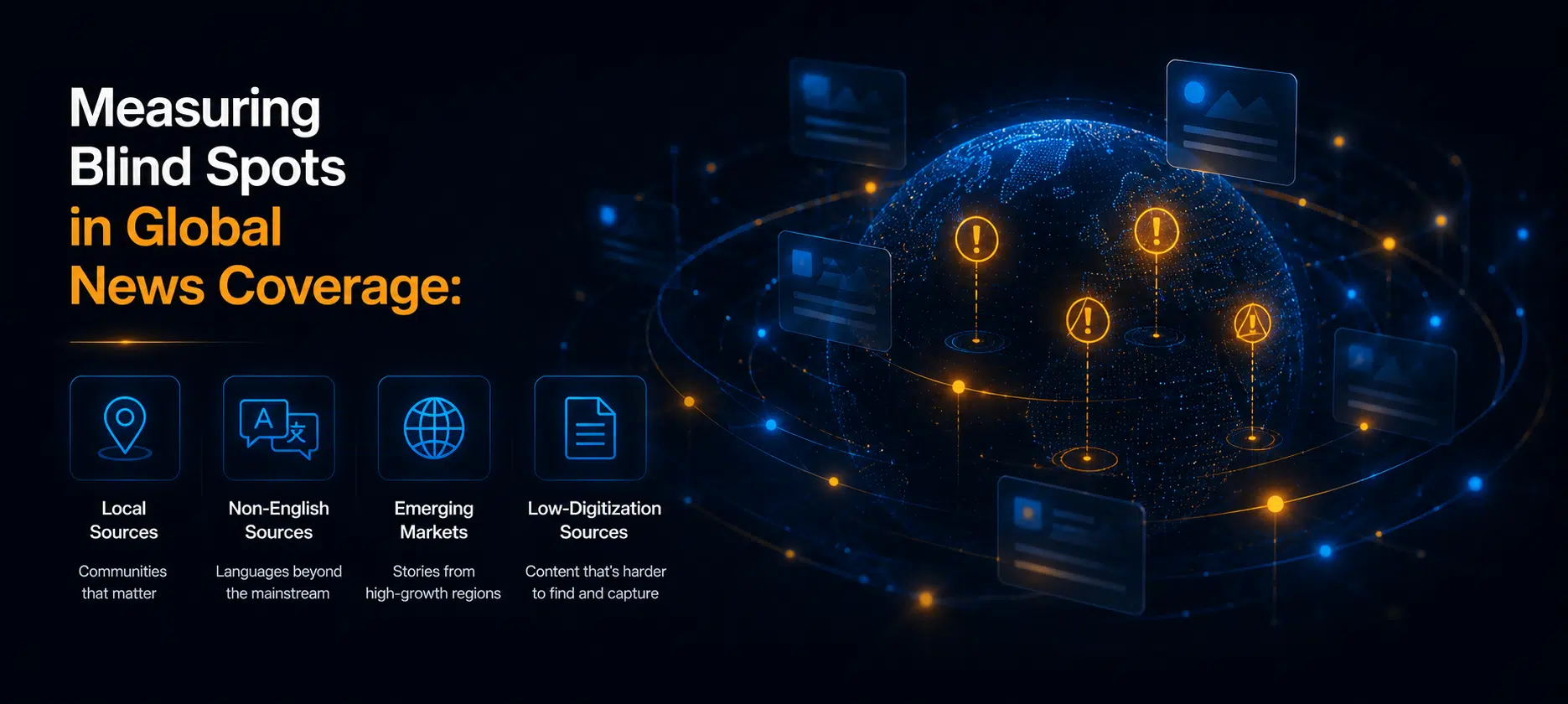
Global news coverage is easy to describe and hard to measure. A platform can collect millions of articles, span hundreds of countries, and support many languages, yet still miss the first source that matters for a specific risk, company, market, or event. The problem is not only scale. The problem is representativeness.
A global news API should answer more than “How much content do you collect?” It should answer “Which parts of the world are visible through the data, which parts are harder to see, and how do we know?” That question matters for media intelligence, financial analysis, risk monitoring, supply chain intelligence, ESG research, geopolitical analysis, and AI applications that use news as live external context.
Blind spots appear when a system underrepresents local outlets, non-English reporting, emerging markets, low-digitization sources, government pages, corporate newsroom pages, trade publications, community media, or regions with weak press freedom. These gaps can change what a user believes is happening. They can make a local risk look invisible, make a global trend look smaller than it is, or make an AI system answer with only the version of the story that reached large English-language media.
Webz.io’s News API is built for broad global coverage, with more than 3.5 million trusted news articles daily, 170-plus languages, and 200-plus countries, delivered as structured and enriched data with entity extraction, sentiment analysis, and deduplication filters. Webz.io also emphasizes direct first-party data from corporate and government newsrooms, which is important because early signals often appear close to the source before they spread through mainstream media.
Coverage sounds like a source count. Visibility is deeper. It asks whether the system captures the sources that matter for a given question, in the language and region where the event first appears.
A global company monitoring third-party risk may care about a small regional outlet in Vietnam, a municipal government page in Brazil, a local court update in South Africa, a labor union announcement in Mexico, or a trade publication in Poland. A financial intelligence platform may need early reporting around regulatory pressure, executive changes, lawsuits, product recalls, or local operational disruptions. A media monitoring company may need to capture a story before it becomes a national headline.
Source count alone can hide uneven visibility. A region may have many sources in the index, while the most important local or sector-specific sources are missing. A language may have thousands of articles, while key dialects, transliterations, or local spellings remain difficult to retrieve. A country may appear well covered through international media, while domestic reporting is sparse.
This is why global coverage should be evaluated through blind-spot testing. The goal is to measure what the API sees, what it sees late, and what it misses.
Local news is one of the most important blind-spot categories because many major stories begin locally. A factory fire, strike, protest, lawsuit, environmental incident, port delay, cyberattack, public health issue, or political scandal may appear first in a local outlet before national media pick it up. For a risk system, those early local signals can be the difference between monitoring history and detecting risk in time to act.
The challenge is structural. Local journalism is under pressure in many markets. In the United States, Medill’s 2025 State of Local News Report found that local news deserts reached record levels, with around 50 million people having limited access to local news. The World Justice Project describes local news deserts as a global phenomenon connected to the media industry crisis and the disappearance of printed media, with consequences for polarization, misinformation, and public truth.
For news API buyers, this means local coverage should be tested directly. A trial should include local outlets that have historically broken relevant stories, not only large national publishers. The test should compare how quickly the API captures local reports, whether the source metadata is clean, whether the story is classified correctly, and whether the local article remains visible once larger outlets publish rewritten versions.
The most useful measurement is first-source recall. Pick a set of known events where the earliest reliable mention came from a local source. Then test whether the API captured that first source, when it appeared, and whether the article was retrievable through the query fields your product uses. This reveals whether the platform has local depth or only later mainstream amplification.
Non-English coverage is not simply English coverage in another language. It has its own source universe, naming conventions, spelling variants, entity ambiguity, local terminology, and publication patterns. A company may appear under a legal name, local brand name, translated name, acronym, ticker, former name, or parent-company reference. A place may appear in several transliterations. A political event may be described through local phrases that a direct translation would miss.
Reuters Institute’s Digital News Report 2026 describes news consumption as a global, fast-moving environment shaped by political, economic, technological, and climate turbulence. It also points to changing audience behavior across countries and platforms. That global complexity matters for news data because a monitoring system built around English-language assumptions will often miss how events are framed in the places where they happen.
Non-English blind-spot testing should include native-language queries, translated queries, entity aliases, and local spellings. It should test both headline matches and body-text matches. It should compare source coverage across languages and check whether article metadata preserves the original language, country, source, URL, title, publication time, and entity context.
Entity accuracy is especially important here. A keyword match can find an article, but a structured news API should help determine whether the article actually refers to the intended company, person, place, product, or event. Webz.io’s News API includes advanced entity extraction and sentiment analysis, which helps turn multilingual news into structured data that downstream systems can filter, score, and analyze.
Emerging markets are often treated as part of global coverage, but they should be evaluated as a separate category. These markets may have different publishing ecosystems, stronger reliance on local or regional outlets, more fragmented language patterns, more mobile-first consumption, and varying levels of digital infrastructure. Some high-signal sources may publish irregularly. Others may use weak metadata, unstable URLs, or limited feeds.
A global coverage test should therefore include country-level and city-level benchmarks for emerging markets. For example, a supply chain intelligence platform may need coverage in Indonesia, Vietnam, Mexico, India, Brazil, Turkey, South Africa, Poland, and the Gulf states. A financial risk platform may need coverage across frontier and emerging exchanges. A brand intelligence platform may need regional media and local business publications in the markets where customers actually operate.
The test should avoid broad searches that flatter the index. Instead, it should use concrete historical events and known local sources. The question is not whether the API can return articles about India or Brazil. The question is whether it captured a regional factory shutdown, a local regulatory action, a court decision, a product recall, a labor dispute, or a government notice when it first appeared.
GDELT provides a useful reference point for thinking about global monitoring because it describes its system as monitoring broadcast, print, and web news from nearly every corner of every country in more than 100 languages, identifying people, locations, organizations, themes, emotions, events, and other signals. The lesson for buyers is that geographic breadth must be measured through actual event visibility, language handling, and source diversity rather than a simple map of countries.
Some news blind spots come from the structure of the web itself. A source may be influential offline but weak online. A government office may publish PDFs instead of article pages. A local outlet may update social channels faster than its website. A trade publication may use old CMS templates with poor metadata. A newsroom may publish through a feed that breaks often. A court, regulator, or agency may publish notices in formats that are hard to parse.
These are low-digitization sources. They create coverage gaps because the information exists, but it is hard to collect, normalize, search, or enrich. For global news monitoring, this is one of the hardest problems because the most important sources are not always the most technically accessible ones.
Low-digitization blind spots should be measured through source audits. Start with a list of sources that matter to the business. Check whether each source publishes through HTML pages, RSS feeds, sitemaps, PDFs, press-release systems, social channels, or document portals. Then test whether the API captures those updates, extracts clean text, preserves the right timestamps, and attaches usable metadata.
This matters for AI systems as well. A retrieval model can only ground answers in what it can access. When low-digitization sources are missing, the model may rely on later summaries or larger outlets that rewrite the original information. That can weaken traceability and reduce confidence in the answer.
A global news API also reflects the health of journalism in each market. In some countries, independent reporting is strong. In others, journalists face legal pressure, political pressure, violence, ownership concentration, censorship, or self-censorship. UNESCO’s 2022/2025 World Trends report warns of a 10% global decline in freedom of expression between 2012 and 2024 and points to self-censorship, hostility toward journalists, and attacks online and offline.
This matters because news coverage gaps can come from reality, not from the API. If local journalism is weakened, certain stories may receive less original reporting. If a market has strong censorship or economic pressure, some topics may appear only through foreign outlets, diaspora media, NGOs, official notices, or social channels. If journalists face safety risks, the first credible signal may arrive late or indirectly.
A mature blind-spot measurement framework should therefore separate collection gaps from media-system gaps. A collection gap means the source exists and publishes relevant content, but the API does not capture it. A media-system gap means the source ecosystem itself produces limited public reporting on the topic. Both affect the user, but they require different responses.
For collection gaps, the solution may involve adding sources, improving crawl frequency, supporting new formats, or tuning queries. For media-system gaps, the solution may involve complementary data sources, official feeds, blogs, forums, corporate newsrooms, government sources, or regional monitoring strategies.
The best way to measure blind spots is to build a coverage map. This map should show coverage by country, language, source type, source authority, topic, and latency. It should separate national media from local media, official sources from commercial publishers, trade publications from general news, and domestic sources from foreign coverage about the same country.
A coverage map becomes useful when it is tied to business questions. A company monitoring supplier risk should map sources around supplier locations, ports, industrial zones, government agencies, labor organizations, trade press, and regional newspapers. A financial platform should map business press, regulatory sources, company newsrooms, market-specific publications, and analyst-relevant outlets. A media intelligence company should map top-tier, local, trade, and long-tail outlets by customer market.
Webz.io describes access to more than 300,000 news sites, 200-plus jurisdictions, and 170-plus languages, with AI-powered categorization, sentiment scoring, and granular entity extraction. For buyers, the practical next step is to connect that global infrastructure to a use-case-specific coverage map. Broad coverage creates the base. Measurement turns it into confidence.
Keyword testing gives a partial view of coverage. Event testing gives a stronger view. A keyword test asks whether the API can return articles matching a word or phrase. An event test asks whether the API captured a real-world development across the sources, languages, and regions where it appeared.
Event testing should use a gold set. This set can include known incidents, regulatory actions, lawsuits, strikes, product recalls, M&A rumors, executive changes, protests, cyber incidents, natural disasters, and company announcements. Each event should include the earliest known source, important follow-up sources, relevant local-language coverage, and the expected entity matches.
Then the evaluation should measure whether the API captured the event, which source appeared first, how long discovery took, whether the right entities were extracted, whether duplicate stories were grouped or filtered properly, and whether source metadata supported trust. This approach exposes blind spots that broad source counts cannot show.
Academic work using GDELT has shown that global news coverage can have strong regional patterns. A study of disaster coverage found that factors such as population, political stability, damage, and regionalism help shape global coverage, and the authors highlighted the need for comprehensive datasets to study global news geography. This reinforces the point: global visibility is uneven by nature, so coverage evaluation must measure the shape of that unevenness.
Blind spots can also appear when an event crosses languages or regions. A story may begin in a local language, then appear in regional media, then reach English-language international coverage. During that path, details can change. Names can be translated inconsistently. Locations can be generalized. Local context can disappear. The story can shift from specific evidence to a broad summary.
This creates language and region drift. A monitoring system should help users follow the story from origin to amplification. It should preserve the earliest local source, capture later translations or rewrites, identify the same entities across languages, and show how coverage changes over time.
To measure this, choose events that started locally and later reached international coverage. Compare the original local-language article with later articles in other languages. Look for missing details, entity mismatches, timestamp gaps, duplicate handling, sentiment differences, and source attribution. The goal is to understand whether the API captures the full story path or only the final English-language version.
This is especially important for AI applications. An AI system that sees only the later international version may produce a clean answer but miss the local evidence. A system with access to multilingual source depth can provide a richer and more grounded summary.
Coverage gaps are not abstract. They affect product performance and business outcomes. A risk platform that misses local incidents may understate exposure. A financial platform that misses regional regulatory news may lag the market. A brand monitoring tool that misses non-English sentiment may misread reputation. An AI assistant that misses original sources may cite weaker secondary coverage.
These risks compound at scale. When a monitoring product serves customers across many countries, every blind spot becomes part of the product experience. Users may not know which sources were missing. They only see that an alert arrived late, a dashboard looked incomplete, or a report failed to capture what local teams already knew.
This is why blind-spot measurement should be a recurring process, not a one-time vendor evaluation. Source ecosystems change. Local outlets close. New publications appear. Government websites migrate. Newsrooms change CMS platforms. Language use shifts. Political pressure changes reporting behavior. The coverage map should be reviewed and updated over time.
The strongest global news coverage strategy combines scale with measurement. Scale gives access to millions of articles, many languages, and many countries. Measurement tells teams where that access is strong, where it is thin, and where it needs improvement for a specific use case.
A practical blind-spot framework should measure local source depth, non-English retrieval, emerging-market event recall, low-digitization source handling, source-type diversity, entity accuracy, latency by region, and first-source capture. It should use real historical events and live monitoring tests. It should compare what the system captured against what the business needed to know.
Webz.io’s News API gives teams a broad, machine-ready foundation for this work: daily trusted news coverage at global scale, support for 170-plus languages and 200-plus countries, structured delivery, enrichment, deduplication, and direct first-party data from corporate and government newsrooms. The next step for any serious buyer or builder is to measure coverage through the lens of their own risks, markets, entities, and users.
A global news API should help teams see the world as it is reported, not only as it is amplified. The best coverage strategy finds the local article before it becomes a national story, captures the non-English source before it is translated, tracks the emerging-market signal before it reaches global media, and preserves source context so every downstream system can act with confidence.



Do you use Python? If so, this guide will help you automate supply chain risk reports using AI Chat GPT and our News API.

Use this guide to learn how to easily automate supply chain risk reports with Chat GPT and news data.

A quick guide for developers to automate mergers and acquisitions reports with Python and AI. Learn to fetch data, analyze content, and generate reports automatically.