




How to Automate Supply Chain Risk Reports: A Guide for Developers
Do you use Python? If so, this guide will help you automate supply chain risk reports using AI Chat GPT and our News API.

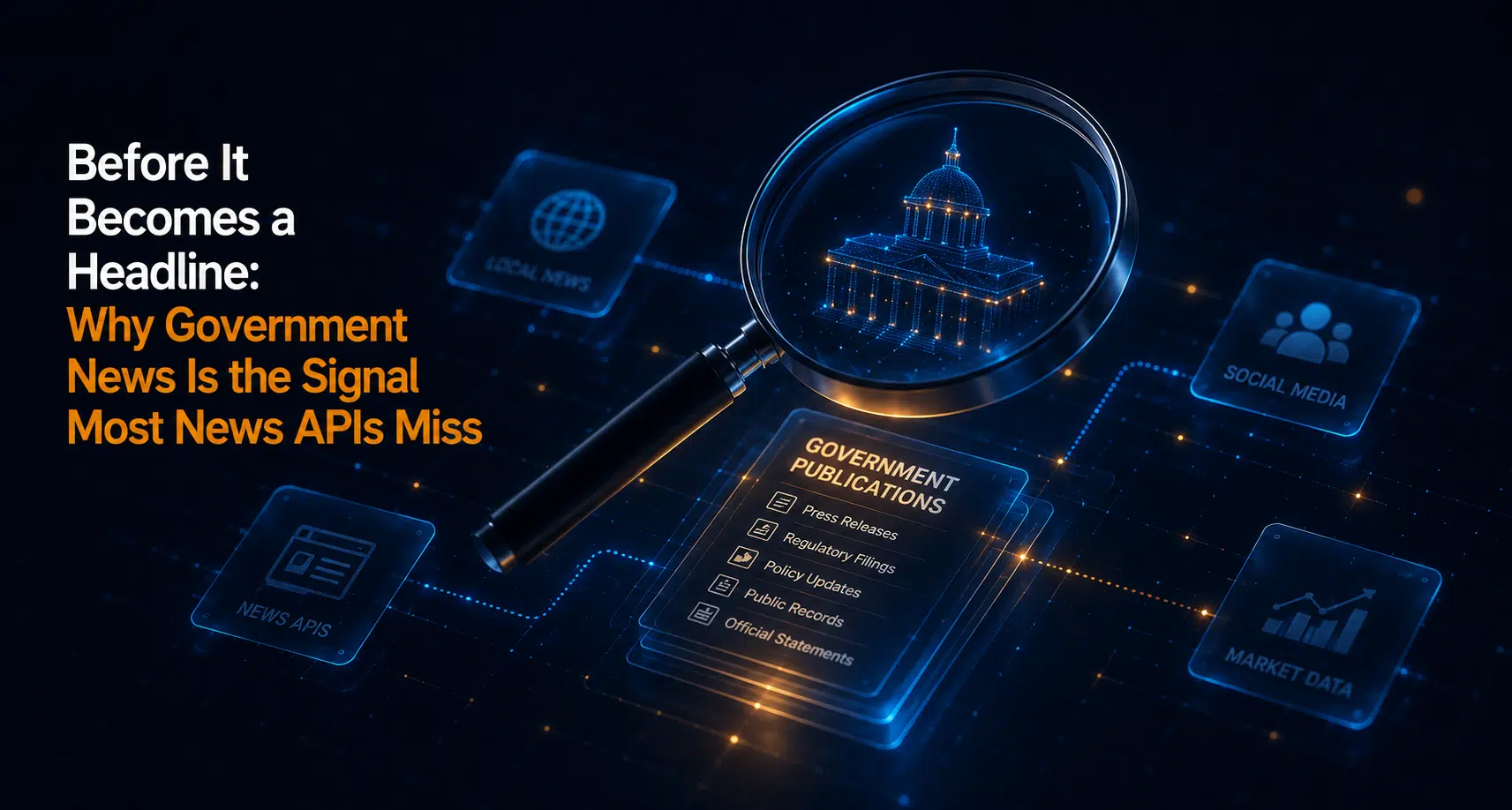
Most news monitoring begins too late.
By the time an event appears in a major publication, it has already passed through several stages. An agency issued a notice. A regulator published a filing. A municipality announced a restriction. A health authority released an advisory. A journalist then discovered the information, verified it, added context and decided that it was relevant enough to cover.
Mainstream reporting is often the first time the public sees an event. It is rarely the first time the event becomes visible online.
Government news sits closer to the source. It records what public authorities have announced, approved, prohibited, investigated, recalled, funded or changed—often before those actions receive broad media attention. For organizations building risk intelligence, financial monitoring, media analytics or AI systems, that makes government news a distinct data layer rather than simply another category of publisher.
Traditional news tells you what editors and journalists consider important. Government sources tell you what public institutions are doing.
That difference matters because government bodies publish for operational, regulatory and legal reasons, not only because a story is likely to attract an audience. A safety notice, environmental permit, enforcement action or municipal procurement decision may be too narrow for a national publication. It can still have immediate consequences for a company, industry or location.
In the United States, documents on the Federal Register’s Public Inspection Desk are normally available for review one business day before formal publication. This means proposed rules, notices and agency actions can become publicly visible before they enter the regular news cycle.
The SEC offers a similar example. Its EDGAR system provides access to company disclosures and includes a feed of filings as they are submitted. A significant ownership change, executive departure, legal proceeding or material corporate event may appear in a filing before a journalist writes about it.
Public safety information can move even faster. The USGS says earthquake information is posted in an average of about 2.5 minutes for California, eight minutes elsewhere in the United States and 20 minutes for many international events. These records provide location and magnitude data while social posts and news reports may still be based on incomplete eyewitness accounts.
The CDC’s Health Alert Network is designed to distribute urgent public-health information to more than one million recipients, including clinicians, laboratories and public-health authorities. These alerts are operational signals intended to prompt action, not articles written for a general audience.
In each case, the government source is the zero-hop signal: the information comes directly from the organization responsible for filing, regulating, measuring or responding to the event.
Describing government sources as trusted can create the wrong impression. Governments can make mistakes. Officials can frame events in their own interests, publish incomplete information, delay announcements or revise earlier statements.
An official source should therefore not be treated as an unquestionable description of reality.
Its value is more specific: provenance.
A government page provides strong evidence of what a named public body placed on the record at a particular time. It gives the information an identifiable issuer, jurisdiction, publication date and institutional context. In some cases, it also provides a formal amendment or authentication trail.
The U.S. Government Publishing Office, for example, digitally signs official PDF publications so users can verify their source and confirm that the documents have not been altered since publication.
This distinction is especially relevant when general confidence in institutions is low. Pew Research Center found that only 17% of Americans said in September 2025 that they trusted the federal government to do what is right most or all of the time. Across the OECD, 39% reported high or moderately high trust in their national government, while only 41% believed governments used the best available evidence when making decisions.
A government news API should not label every official claim as fact. It should tell users that the information came directly from an official source. That lets analysts, models and applications distinguish a government announcement from a journalist’s interpretation, a company response, a social-media reaction or an anonymous claim.
Trust, in this context, is not agreement. It is traceability.
The most valuable government signals are often not dramatic when first published.
A local authority may report unusual water-test results. A ministry may introduce a consultation on a technical rule. A regulator may issue several small enforcement actions against companies in the same sector. A health department may report a cluster of cases in one region. A transportation agency may close a route used by a major supply chain.
Each event can look isolated. Together, they may indicate an emerging regulatory, operational, environmental or public-health risk.
Mainstream news outlets have to prioritize. They usually cover a development once it affects a large audience, involves a recognizable organization or fits an established narrative. Intelligence systems cannot always wait for that threshold.
For a pharmaceutical company, an agency notice involving one manufacturing facility may be material before it becomes a national story. For a commodity trader, restrictions announced by a regional agricultural authority can matter before financial publications notice them. For a supply-chain platform, a port authority update may be more actionable than the later article describing its economic effects.
The value is not merely being several minutes faster. It is detecting events that may never receive broad coverage at all.
The FDA notes that not every recall results in a press release or appears on its public recall page. Its weekly Enforcement Report may contain recalls after they have gone through the agency’s classification process. A system monitoring only popular articles—or even only the most visible government announcements—can therefore miss meaningful regulatory activity.
There is no single global government newsroom.
Relevant information is spread across national ministries, regulators, municipal authorities, public-health departments, law-enforcement agencies, courts, environmental bodies and thousands of specialized institutions. Each publishes differently.
Some maintain well-structured newsrooms. Others publish notices as PDFs, tables, bulletins or updates buried inside departmental websites. Naming conventions differ between jurisdictions. Agencies reorganize. URLs change. The same type of event may be described differently across languages and countries.
A company trying to monitor this manually faces two separate problems.
The first is collection: finding the relevant government sections and checking them frequently enough to detect new information.
The second is normalization: converting the material into consistent records that can be searched by organization, location, topic, agency, date or event type.
This is where a government news API becomes more than a list of official websites. It turns a fragmented publishing environment into a dataset that applications can search and analyze alongside other forms of news.
Webz.io allows News API users to isolate content collected from official government news sections with the trust.source.type:gov_news filter.
The API also provides government-source fields such as agency, organization name, city, state, country and domain type. This makes it possible to search by institutional and geographic context rather than relying entirely on keywords appearing inside an article.
A risk platform could monitor government announcements mentioning a supplier across several countries. A financial-intelligence application could search for official actions related to a company, industry or ticker. A compliance product could track selected regulators and jurisdictions. A media-monitoring system could detect an original government notice and then measure how the story moves into local, trade and national publications.
Webz.io’s broader News API adds structure around those records through entity extraction, article categorization, sentiment, historical search and geographic filters. It also distinguishes government sources from local news and company newsrooms. This means customers do not have to flatten all first-party and journalistic content into one undifferentiated stream.
That source separation is particularly useful for AI and retrieval-augmented generation systems. An AI product answering a question about a regulation should be able to prioritize the regulator’s original announcement while still retrieving independent reporting that explains its effects or challenges its claims.
The government source establishes what was announced. Journalism provides verification, opposition, expert interpretation and consequences. A reliable system needs both.
A conventional news API answers:
What is the media reporting?
A government news API adds a different question:
What have public authorities placed on the record?
The difference between those two datasets can reveal valuable information.
Analysts can measure how long it takes an official notice to reach mainstream publications. They can identify agency announcements that receive little or no coverage. They can detect repeated local actions before they are recognized as a larger pattern. They can compare an institution’s original language with the way the event is later framed by the media.
This changes monitoring from a purely reactive process into a form of event discovery.
The first signal may be a regulatory notice that receives no shares, has no dramatic headline and appears on a website few people visit. Its relevance comes from who published it, what action it records and which organizations or locations it affects.
Official sources document institutional positions and actions. They do not necessarily explain who benefits, who is harmed, what was omitted or whether the stated reasoning is sound.
That work still requires journalists, researchers, local sources and subject-matter experts.
The best intelligence systems therefore use government news as one layer in a wider evidence model:
Webz.io’s trust-source filters allow applications to keep these layers identifiable while searching them through a common news infrastructure.
By the time a development becomes a major story, much of its informational value may already have been priced into markets, incorporated into operational decisions or recognized by specialists.
Government news provides access to the stage before that happens.
It does not eliminate uncertainty, bias or misinformation. It gives intelligence systems something equally valuable: a direct, attributable and time-stamped signal from the institution responsible for the action.
In an environment dominated by recycled stories, summaries and commentary, access to the original public record is a competitive advantage.
The headline tells you what has captured attention.
The government source may tell you what will capture attention next.



Do you use Python? If so, this guide will help you automate supply chain risk reports using AI Chat GPT and our News API.

Use this guide to learn how to easily automate supply chain risk reports with Chat GPT and news data.

A quick guide for developers to automate mergers and acquisitions reports with Python and AI. Learn to fetch data, analyze content, and generate reports automatically.