




How to Automate Supply Chain Risk Reports: A Guide for Developers
Do you use Python? If so, this guide will help you automate supply chain risk reports using AI Chat GPT and our News API.

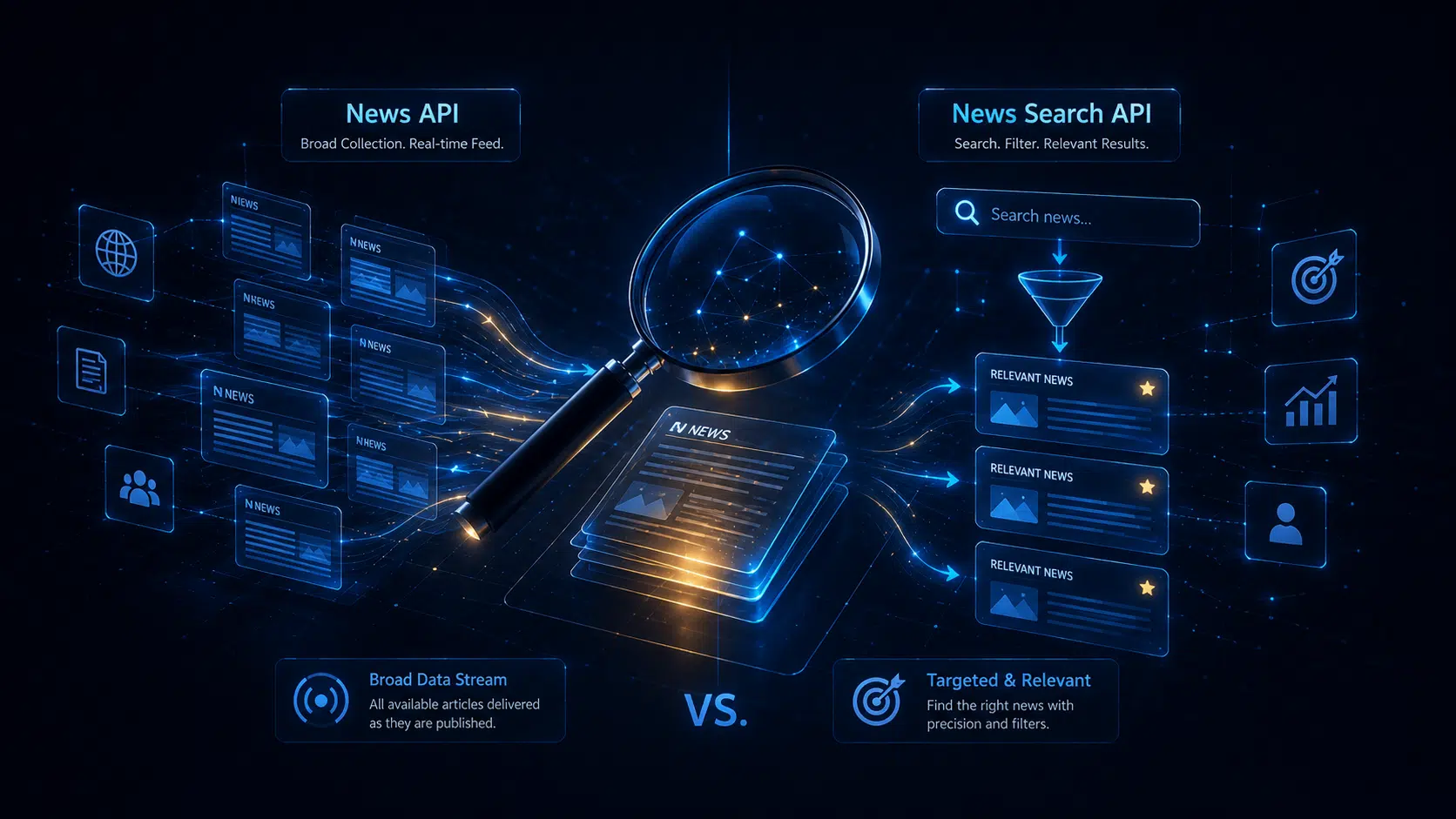
Developers looking for access to news data increasingly encounter two similar-sounding products: a News API and a News Search API.
Both provide programmatic access to news articles. Both can power monitoring systems, research tools, AI applications, dashboards, and automated workflows. The difference is in how you ask for information and what you expect the API to return.
A traditional News API is built primarily for structured retrieval and filtering. A News Search API is built for relevance-driven discovery, where the query describes the information you want rather than every rule for finding it.
Understanding that distinction helps determine which API fits a particular application.
A News API gives developers structured access to articles collected from news publishers across the web.
Applications typically query the API using keywords together with filters such as publication date, language, country, source, category, sentiment, entities, or other metadata.
For example, an application monitoring NVIDIA could search for articles containing the company name published in English during the last 24 hours. It could further restrict the results to technology publications, particular countries, or selected domains.
This makes a News API especially useful when the application already knows what rules define the dataset it needs.
A media monitoring platform might continuously retrieve articles mentioning a brand. A financial intelligence system might collect everything mentioning a list of companies or stock tickers. A research platform might download articles matching a Boolean query and analyze them internally.
The News API acts primarily as a structured interface to the underlying news corpus.
A News Search API starts from a different question.
Instead of asking only, “Which articles match these keywords and filters?”, it asks, “Which parts of the news corpus are most relevant to this query?”
That distinction becomes especially useful for AI systems.
Consider a user asking:
How are European manufacturers responding to higher energy costs?
A traditional keyword search could attempt to translate that request into terms such as:
manufacturers AND Europe AND "energy costs"
That may retrieve useful articles, but it can also miss stories describing the same issue using different language.
A contextual News Search API can interpret the meaning of the query and rank relevant news accordingly.
Webz.io’s News Search API uses hybrid retrieval that combines semantic search with keyword-based BM25 ranking. This allows it to use the meaning of a query while still taking explicit terminology into account.
The result is closer to the behavior developers expect from modern search engines and retrieval systems.
The simplest way to understand the difference is to think about retrieval versus discovery.
A News API is usually best when your application knows exactly what it wants to collect.
A News Search API becomes useful when your application knows the question it wants answered.
Imagine a cybersecurity company tracking articles about a particular ransomware group. A News API query can continuously collect articles mentioning that group’s name and aliases. The predictable query makes traditional filtering effective.
Now imagine an analyst asks:
Which recent attacks involved compromised third-party software providers?
The relevant articles may contain phrases such as “supply-chain compromise,” “vendor breach,” “software update attack,” or none of those exact terms. Contextual search can identify articles discussing the underlying concept rather than depending entirely on a predefined keyword list.
The first problem is data retrieval. The second is information discovery.
Large language models have changed how applications interact with news data.
Traditional software frequently starts with predefined rules. AI applications increasingly start with natural-language questions.
A user might ask:
What happened this week that could affect semiconductor supply chains?
An AI agent could attempt to generate a complex Boolean query, retrieve hundreds of articles, rank them, remove irrelevant results, extract useful passages, and then send those passages to a language model.
A News Search API can move part of that work into the retrieval layer itself.
Webz.io’s news API for AI, returns relevant article segments, or chunks, rather than requiring an AI application to treat every complete article as a single search result. These chunks can be passed directly into RAG pipelines, AI agents, summarization systems, or other downstream models.
This reduces the amount of irrelevant text entering the context window and makes retrieval more closely aligned with the original question.
Contextual search does not replace structured news retrieval.
Many applications need predictable, comprehensive collection rather than ranked relevance.
A media monitoring system that must capture every mention of a company should favor deterministic queries. A compliance archive may need all articles from specific sources. A market intelligence system may continuously ingest articles matching hundreds of known companies, industries, and topics.
These applications benefit from the filtering and query controls available through a traditional News API.
Webz.io’s News API supports searches across news content using keywords and Boolean queries together with structured metadata and filters. Developers can use it to build repeatable queries and retrieve the matching articles for their own processing.
The objective is coverage of a defined dataset rather than finding the handful of results most relevant to an open-ended question.
A semantic news search API fits applications where relevance matters more than exhaustive retrieval.
RAG systems are a clear example. An AI application answering a question about current events rarely needs every article containing the same keywords. It needs a small collection of highly relevant passages that provide enough evidence to answer the question.
The same applies to research assistants, due diligence tools, AI agents, investigative platforms, competitive intelligence products, and automated briefing systems.
A user could search:
Recent regulatory problems involving cryptocurrency exchanges in Asia
The application can search directly for the concept instead of requiring the user or developer to construct every combination of terms that could describe it.
Structured filters can still narrow the search by geography, language, date, category, sentiment, or other criteria. Contextual ranking then determines which results inside that dataset are most relevant.
That combination is particularly useful because semantic relevance alone rarely provides enough control for professional news applications.
Semantic search sometimes gets presented as a replacement for filters. In news applications, the two solve different problems.
Meaning determines what is relevant. Filters determine where the search is allowed to look.
An analyst might search for:
Companies facing layoffs after failed funding rounds
The semantic query defines the concept. The application can then restrict the results to articles from the United States, published during the previous 30 days, written in English, and belonging to business or technology categories.
This produces a much more useful retrieval system than either approach alone.
Webz.io’s News Search API combines natural-language and contextual search with structured news metadata, giving developers both forms of control.
Traditional news monitoring often requires substantial query engineering.
Analysts build lists of keywords, synonyms, company names, product names, spelling variations, exclusions, and Boolean expressions. Those queries can work extremely well for repeatable monitoring, but maintaining them becomes harder as the question becomes broader.
Consider searching for news about companies experiencing operational disruption because of extreme weather.
Relevant articles might discuss factory closures, transportation interruptions, flooding, wildfires, hurricanes, port shutdowns, power outages, or supply-chain delays.
A contextual query can describe the information requirement directly:
Companies whose operations were disrupted by extreme weather
That approach changes the developer’s job. Instead of predicting every phrase a journalist might use, the developer describes the information the application wants to find.
For many applications, the answer is yes.
A traditional News API and a contextual News Search API solve different stages of the same workflow.
A company might use the Webz.io News API to continuously ingest articles about hundreds of monitored companies. Analysts could then use contextual search to investigate questions across that data.
An AI application might use contextual search for interactive questions while relying on structured API queries for scheduled monitoring.
A due diligence platform could run predefined searches for known risk indicators and allow analysts to ask broader questions when investigating a company.
The choice therefore does not have to be permanent or exclusive. It depends on whether the current task is collecting a defined set of news or finding the most relevant information for a particular question.
A useful rule is straightforward.
Use a News API when you can describe the articles you want through explicit keywords, Boolean logic, sources, dates, entities, and metadata filters.
Use a News Search API when you can describe the information you want more naturally than you can describe every possible article that might contain it.
The distinction becomes increasingly important as news data moves from dashboards and monitoring feeds into AI agents and RAG systems.
Traditional APIs give software access to news.
Contextual search APIs help software find the right news for the question being asked.
Webz.io provides both approaches: the News API for structured, large-scale news retrieval and the News Search API for contextual, relevance-ranked discovery across news content. Developers can choose the retrieval method that fits the application instead of forcing every news use case through the same search model.



Do you use Python? If so, this guide will help you automate supply chain risk reports using AI Chat GPT and our News API.

Use this guide to learn how to easily automate supply chain risk reports with Chat GPT and news data.

A quick guide for developers to automate mergers and acquisitions reports with Python and AI. Learn to fetch data, analyze content, and generate reports automatically.