




How to Automate Supply Chain Risk Reports: A Guide for Developers
Do you use Python? If so, this guide will help you automate supply chain risk reports using AI Chat GPT and our News API.

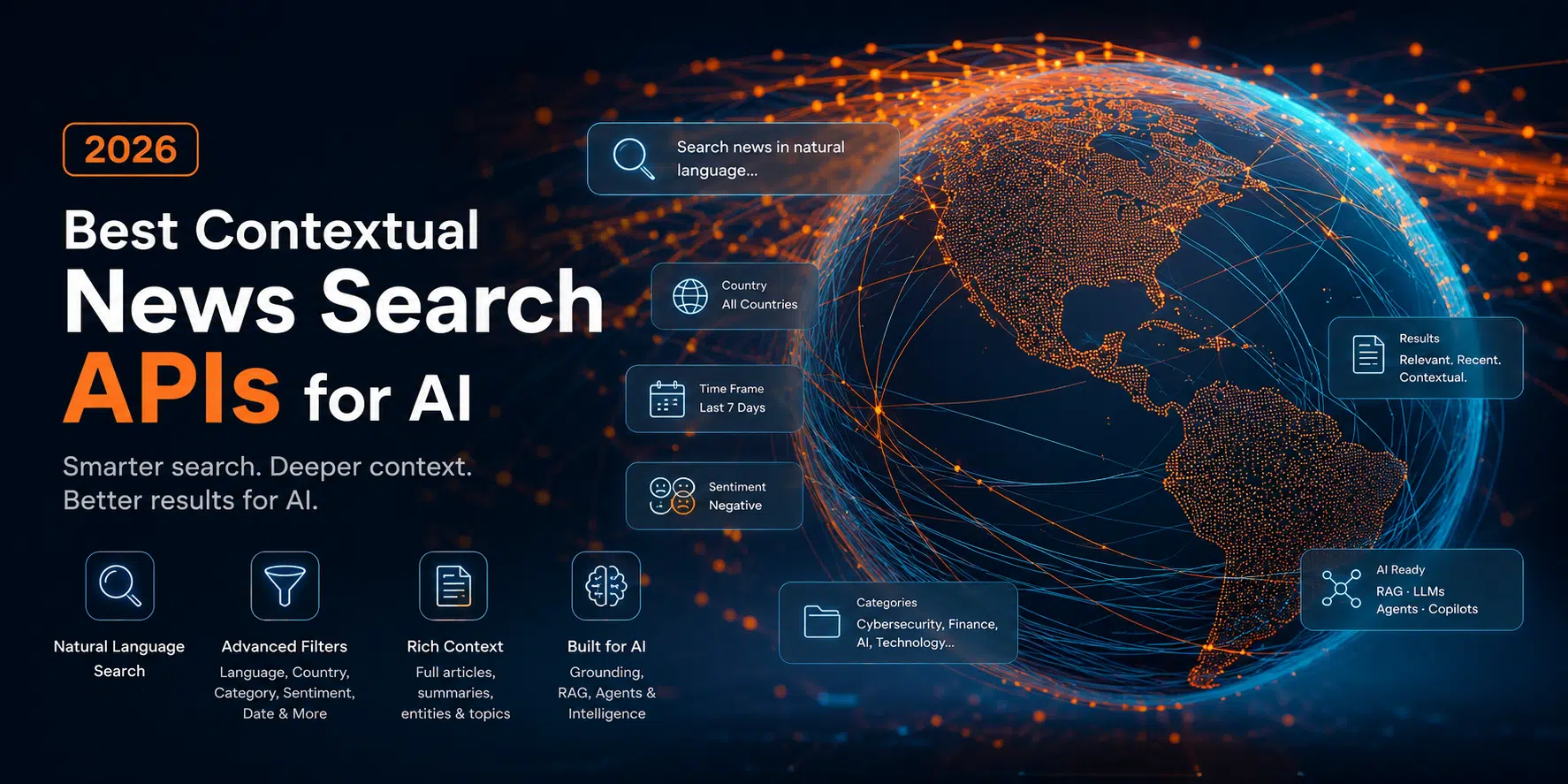
Traditional news APIs are designed around keywords.
You send:
NVIDIA AND China
and receive articles containing those terms.
That works for feeds and monitoring rules, but it is a poor fit for many AI applications. An AI agent may need to find:
Companies moving semiconductor production out of China because of new trade restrictions.
The relevant articles may use phrases such as “supply-chain diversification,” “new manufacturing capacity in Vietnam,” or “tariff exposure” without containing the exact wording in the query.
That is why a new category of search API has emerged: contextual search APIs built for AI.
These APIs accept natural-language queries, rank results based on meaning, and usually return the specific passages most relevant to the query. Instead of giving an AI system ten links and making it process every page, they can provide compact, relevant context that can go directly into an LLM.
For news applications, there is another requirement: freshness. AI systems researching markets, companies, geopolitical events, security incidents, or current affairs need retrieval built around continuously changing information.
This comparison focuses specifically on APIs that can provide that kind of contextual news retrieval.
| API | News specialization | Contextual / semantic retrieval | Relevant passages | News-specific filters | Best for |
|---|---|---|---|---|---|
| Webz.io News Search | Dedicated news search | Yes | Yes | Strong | News RAG, monitoring, intelligence |
| Exa | News search within broader web index | Yes | Yes | Moderate | General AI search + news |
| Tavily | Dedicated news search mode |
Yes | Yes | Moderate | AI agents and research |
| You.com | News integrated with web search | Yes | Yes | Basic | AI assistants and grounding |
| Brave Search API | Dedicated news endpoint | Search + LLM context | Yes | Basic | Large-scale web/news grounding |
| Linkup | General web search | Agentic contextual search | Yes | Basic | Agents and multi-step research |
Webz.io is different from most of the other APIs in this comparison because its contextual search product is built specifically around a large news corpus rather than the general web.
The News Search API accepts natural-language queries and finds articles based on meaning rather than requiring exact keyword matches.
For example:
European manufacturers reducing their dependence on Chinese suppliers because of geopolitical risk
An AI application can send that directly as the query instead of trying to convert it into a long Boolean expression.
The API then returns the matching articles together with the relevant text excerpt from each article. That is particularly useful for RAG because the model receives the section that caused the article to match rather than having to process the entire document.
Contextual relevance is only one part of news retrieval. Suppose an AI risk-monitoring system searches for:
Companies facing regulatory investigations over data privacy
Finding semantically relevant articles is useful. But the application might also want only:
Webz.io lets developers combine a natural-language query with structured filters for country, language, source, publication date, sentiment, and category.
That distinction matters. Most AI search APIs are trying to answer:
Which pages on the web are relevant to this question?
Webz.io can answer a more specific question:
Which news articles are contextually relevant to this question and meet the monitoring criteria of my application?
Webz.io says its news collection covers more than 3.5 million articles per day from 300,000+ news sites across 170+ languages and 200+ countries.
The contextual News Search API currently searches news from the previous 30 days.
Webz.io also provides an MCP server, allowing ChatGPT, Claude, Cursor, and other compatible agents to call the News Search API as a tool.
An agent can make requests such as:
Find recent news about European defense companies receiving new government contracts.
and receive titles, URLs, publication dates, and the matching article excerpts. The MCP interface also exposes country, language, domain, sentiment, category, and date controls.
Webz.io uses a simple usage model:
A query returning ten results therefore costs roughly $0.006.
Best for: news RAG, AI research tools, media intelligence, financial intelligence, adverse media, risk monitoring, and AI agents that need both contextual relevance and structured news filters.
Exa is one of the closest competitors when contextual retrieval is the main requirement.
It is a search engine built specifically for AI systems and accepts long, semantically rich natural-language queries. Exa also provides a dedicated news category for retrieving current journalism.
A query might look like:
AI companies signing agreements with national governments to build sovereign AI infrastructure
Rather than relying only on exact keyword matches, Exa ranks pages by topical relevance.
One of Exa’s strongest features is its highlights output.
Instead of returning an entire article, Exa can extract the sections most relevant to the query. Exa describes this as a token-efficient format for agents, returning significantly less content than retrieving the complete page.
Developers can choose between:
Exa also supports publication-date filtering and domain inclusion/exclusion for news searches. Its news search covers major publications, trade press, and niche sources.
The main difference from Webz.io is scope.
Exa searches much more than journalism. Its categories include:
That makes Exa particularly useful when an agent needs to move between different types of sources.
For example, an investment agent could find recent news, then retrieve a company’s financial report, then search the broader web for additional context.
The tradeoff is that Exa has fewer news-specific classification filters. It provides source and date controls but does not expose the same kind of article-level news taxonomy, sentiment, or source classification available from a dedicated news dataset.
Exa’s standard Search API currently costs $7 per 1,000 searches, including up to ten results. Additional results increase the cost.
Free accounts currently receive $20 initially and $10 of additional credit each month.
Best for: AI agents and RAG applications that need semantic news search alongside research papers, websites, companies, financial documents, and other web content.
Tavily was designed around AI agents rather than human search interfaces.
Its Search API supports a dedicated:
topic: "news"
mode for current news retrieval. Developers can combine this with time ranges, domain filters, search depth, and other parameters.
More importantly for contextual retrieval, Tavily returns the content from each page that is most related to the search query, together with a relevance score.
Using advanced search, developers can request up to three relevant content chunks from each source.
That makes Tavily well suited to an agent workflow:
Natural-language question
        ↓
Tavily news search
        ↓
Relevant sources
        ↓
Relevant article chunks
        ↓
LLM reasoning
Tavily can alternatively generate an answer itself using the retrieved sources.
Its news mode supports:
Tavily therefore sits somewhere between a web search engine and an AI retrieval layer.
Unlike Webz.io, however, it does not provide detailed news-specific filters such as sentiment or article category. Its filtering model is primarily based on search scope, sources, and recency.
Tavily’s free Researcher plan currently provides 1,000 API credits per month with no credit card required. Pay-as-you-go credits cost $0.008 each.
Best for: AI agents, research assistants, autonomous workflows, and developers who want search, extraction, and optional answer generation from a single provider.
You.com’s Search API combines web and news retrieval in one API designed specifically for AI applications.
Rather than simply returning links, it can return query-relevant highlights from each result. These highlights are passages selected because they address the search query and are intended for token-sensitive agent workflows.
The API can also return full-page Markdown or HTML if the AI application needs more context.
One interesting design choice is that You.com can automatically determine when a query has news intent and include news results alongside web results.
This can work well for general assistants.
A user might ask:
Why are European electricity prices increasing again?
The application does not necessarily need to decide beforehand whether the answer should come from a news article, government site, analysis page, or another web source.
You.com allows up to 100 results per API call and provides:
The main limitation for dedicated news applications is again the depth of the news metadata.
It is strong at finding relevant current information but does not provide the same specialized media-intelligence fields found in a dedicated news database.
The Web Search API costs $5 per 1,000 calls, with up to 100 results available per call.
New accounts currently receive $100 in free API credits. Full-page extraction costs an additional $1 per 1,000 pages.
Best for: AI assistants, agents, RAG systems, and applications that want contextual web and news retrieval through a single API.
Brave is another important option because it operates its own large web search index rather than depending entirely on another search engine.
The API includes both a dedicated News Search endpoint and an LLM Context capability designed to return search material suitable for models and agents.
Brave can provide multiple snippets for a result, giving an AI model more useful context than a conventional search-result description.
The Search API also includes:
Its independent index contains more than 30 billion pages, according to Brave.
There is an important distinction here.
Webz.io and Exa explicitly emphasize semantic retrieval based on the meaning of the natural-language query.
Brave’s strength is slightly different: it combines a mature search engine with LLM-optimized context retrieval.
That can still make it very effective for grounding AI systems, but developers evaluating semantic news retrieval should test their actual queries rather than assuming all of these APIs rank contextual queries in exactly the same way.
Brave Search costs $5 per 1,000 requests and includes $5 in free credits every month.
Best for: AI products that want a large independent web index, news retrieval, and search context optimized for downstream LLMs.
Linkup describes its Search API as web search optimized specifically for AI consumption.
Its API accepts a natural-language question and can return one of three forms:
Linkup also distinguishes between several levels of search.
fast is intended for simple low-latency retrieval.
standard uses agentic search for broader questions.
deep performs several search and retrieval steps for more complex tasks.
For example:
Find recent reports of European automotive suppliers reducing production because of weak EV demand.
could be handled as a contextual research query rather than a collection of keywords.
Developers can filter by:
Linkup also provides an MCP server that lets agents search current information and news using natural-language requests.
Like You.com and Brave, Linkup is primarily a general web retrieval service rather than a specialized news corpus.
Standard search returning raw search results currently costs $0.005 per request. Standard search with a sourced answer or structured output costs $0.006. Deep search starts at $0.05 per request.
Accounts currently receive $20 of free credit that is replenished back to $20 each month.
Best for: AI agents that need contextual web research, multi-step retrieval, cited answers, or structured data extraction.
Although all six APIs can help an AI system retrieve current information, they are solving slightly different problems.
Webz.io starts with a dedicated global news dataset and adds contextual search on top of it.
That gives an AI application two layers:
Semantic relevance
+
News-specific structure
For example:
Find companies experiencing factory shutdowns because of labor disputes
could then be constrained to:
country = Germany
sentiment = negative
category = Business
published = last 7 days
This is particularly valuable for monitoring and intelligence applications where the search needs to be repeatable and tightly controlled.
Exa’s strength is its semantic search infrastructure.
News is one searchable content category among several. The same retrieval stack can find journalism, research papers, company pages, financial reports, or other web pages.
That makes it especially attractive for broad research agents.
Tavily packages search, relevant content extraction, and optional answer generation into a workflow designed for AI agents.
Its news mode makes it particularly easy to use for current-event questions.
You.com is useful when the application does not necessarily want to decide whether a query belongs to news or general web search.
It can return both and provide query-relevant passages ready for the LLM.
Brave offers a very large independent search index with dedicated news results and an LLM-oriented context layer.
It is especially attractive for teams that want one search provider for many different types of real-time retrieval.
Linkup moves further toward agentic retrieval, allowing the search system itself to perform multiple steps and return either sources, answers, or structured output.
| Capability | Webz.io | Exa | Tavily | You.com | Brave | Linkup |
|---|---|---|---|---|---|---|
| Natural-language queries | ✓ | ✓ | ✓ | ✓ | ✓ | ✓ |
| Semantic/contextual retrieval | ✓ | ✓ | ✓ | ✓ | Partial / search-driven | ✓ |
| Dedicated news corpus/mode | ✓ | ✓ | ✓ | ✓ | ✓ | — |
| Query-relevant article passages | ✓ | ✓ | ✓ | ✓ | ✓ | ✓ |
| Full article/page content | ✓ | ✓ | ✓ | ✓ | — | Via fetch |
| Date filtering | ✓ | ✓ | ✓ | ✓ | ✓ | ✓ |
| Domain filtering | ✓ | ✓ | ✓ | ✓ | ✓ | ✓ |
| Country filtering | ✓ | — | Limited | ✓ | ✓ | — |
| Language filtering | ✓ | — | — | ✓ | ✓ | — |
| Sentiment filter | ✓ | — | — | — | — | — |
| News category filter | ✓ | — | — | — | — | — |
| MCP support | ✓ | ✓ | ✓ | ✓ | Common integrations | ✓ |
| General web search | — | ✓ | ✓ | ✓ | ✓ | ✓ |
The table makes the main difference clearer:
Most contextual search APIs are web search engines adapted for AI. Webz.io is a news data platform with contextual AI search added to the news corpus.
That distinction matters most for applications where news itself is the dataset rather than just one possible source of information.
For a general-purpose AI agent, Exa, Tavily, You.com, Brave, and Linkup are all credible options.
The right choice depends on how much of the broader web the agent needs and whether you want the retrieval provider to perform additional reasoning.
For an application specifically built around news, Webz.io has a different advantage: natural-language retrieval sits on top of a structured global news dataset.
That makes it especially suitable for:
The difference becomes more pronounced when the application needs to combine meaning with constraints.
Consider:
Find reports of pharmaceutical companies facing regulatory problems with new drugs.
A general semantic search engine can find relevant pages.
A news-specific contextual API can search for the concept and then constrain the result set by publication date, market, source, sentiment, and category.
For production monitoring systems, that extra control can be just as important as semantic relevance.
A feature comparison only goes so far.
The best test is to take 20–50 real questions that your AI application needs to answer and run them through each API.
Use queries that would be difficult to represent with keywords alone:
Companies moving manufacturing away from China because of geopolitical concerns
European banks facing regulatory pressure over their use of artificial intelligence
Cybersecurity companies acquiring startups to expand into identity security
Automakers reducing EV investment because demand is weaker than expected
Then compare:
Relevance: How many of the first ten results actually answer the question?
Context quality: Does the returned passage contain the useful part of the article?
Freshness: How quickly does a newly published article appear?
Coverage: Which relevant publications are missing?
Filtering: Can your application narrow the search without manipulating the natural-language query?
Token efficiency: How much irrelevant text gets passed to your LLM?
Consistency: Does the same kind of query produce predictable results repeatedly?
Price: What does retrieving ten useful pieces of context actually cost?
For AI applications, cost per useful result is usually more meaningful than cost per API request.
News search for AI is becoming a different product from the traditional news API.
The old model was:
keywords
↓
matching articles
↓
human reads them
The contextual model is:
natural-language intent
↓
contextually relevant news
↓
relevant article passages
↓
LLM reasons over the evidence
Webz.io, Exa, Tavily, You.com, Brave, and Linkup all address parts of this workflow.
The main choice is between a general AI web search API that can also find news and a news-specific contextual search API.
For applications where news is one source among many, a broad provider such as Exa, Tavily, You.com, Brave, or Linkup may make sense.
For products where news is the core dataset, Webz.io combines contextual retrieval with the filtering and structured metadata expected from a dedicated news API.
Webz.io’s News Search API costs $0.001 per API call plus $0.0005 per returned result, and every account currently receives $5 in free API credits every month with no credit card required.
Try the Webz.io News Search API with a question your application actually needs to answer.



Do you use Python? If so, this guide will help you automate supply chain risk reports using AI Chat GPT and our News API.

Use this guide to learn how to easily automate supply chain risk reports with Chat GPT and news data.

A quick guide for developers to automate mergers and acquisitions reports with Python and AI. Learn to fetch data, analyze content, and generate reports automatically.