




How to Automate Supply Chain Risk Reports: A Guide for Developers
Do you use Python? If so, this guide will help you automate supply chain risk reports using AI Chat GPT and our News API.

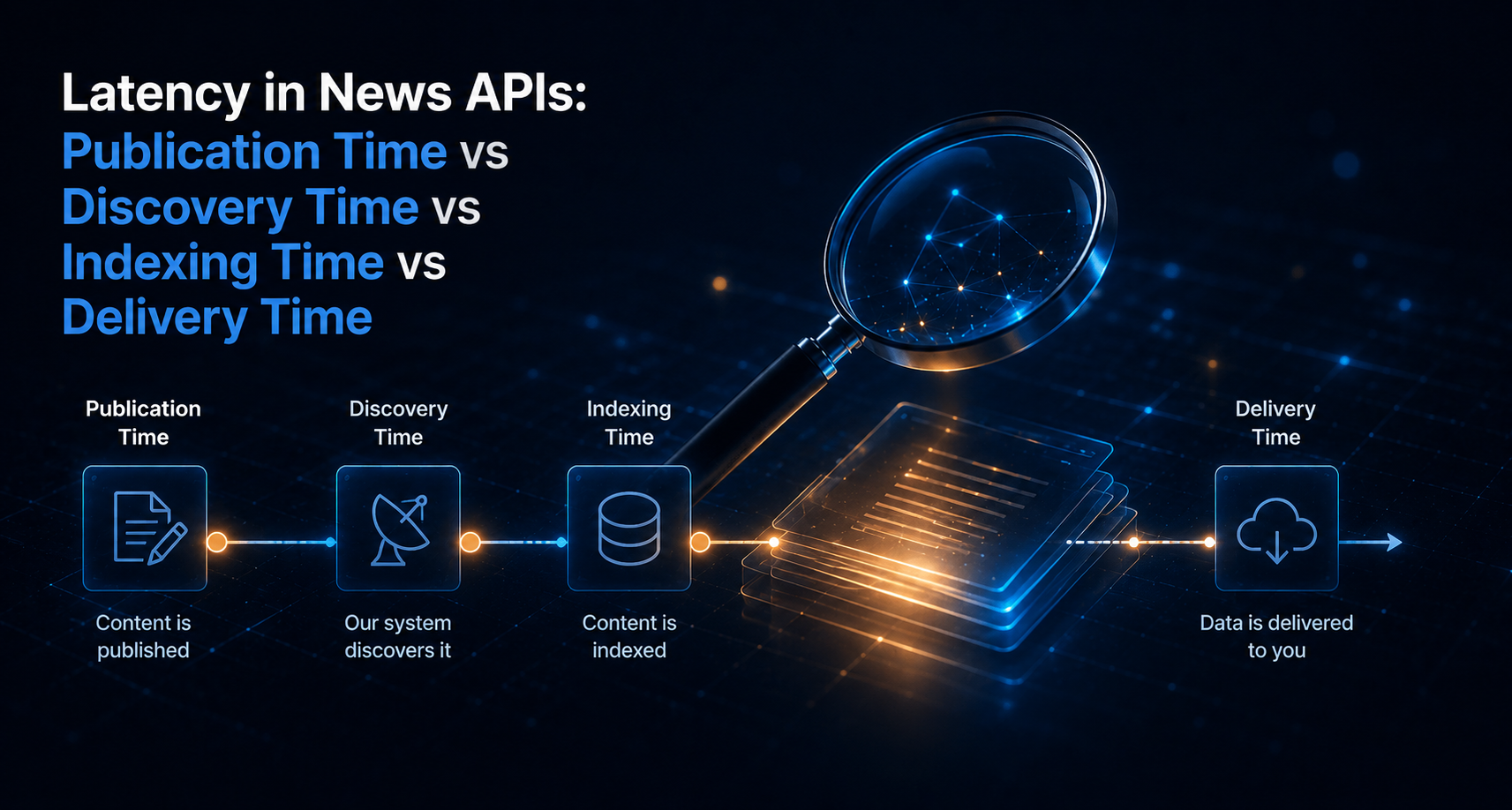
Latency is one of the most important parts of a news API, and also one of the easiest to misunderstand. Buyers often ask whether a news API is real time, but “real time” hides several different clocks. A story can be published by a news source, discovered by a data provider, processed through an indexing pipeline, and delivered to a customer system at four different moments. Each clock affects the value of the data.
For some use cases, the difference between two minutes and twenty minutes changes the product experience. A financial intelligence platform may need early signals around earnings, lawsuits, executive changes, market shocks, and geopolitical risk. A brand monitoring platform may need to detect a crisis before it spreads across mainstream media. A security or risk platform may need early local reporting before a national outlet rewrites the story. A retrieval-augmented generation system may need fresh news context so an answer reflects what just happened.
This is why latency deserves its own evaluation framework. A news API should be measured across the full journey of an article: publication time, discovery time, indexing time, and delivery time.
Publication time is the moment a publisher makes an article available. It is the source-side timestamp. It usually appears on the page itself, in structured metadata, in RSS feeds, in sitemaps, or in the publisher’s content management system output. Google’s article structured data documentation explains that Article, NewsArticle, and BlogPosting markup can help search systems understand page details such as title, image, author, and date information. Schema.org defines NewsArticle as an article that reports news or provides background context and supporting material for understanding news.
Publication time looks simple, but it can be messy in practice. Some publishers update stories after publication. Some display a visible article time while also exposing a separate structured datePublished or dateModified. Some pages change headlines, body text, authors, images, tags, or correction notes after the original version goes live. Some local publishers publish through systems that expose weak or inconsistent metadata. A strong news data pipeline needs to read these signals carefully and preserve enough context for customers to understand the timing of the article.
For buyers, publication time matters because it anchors the event to the publisher’s timeline. It answers a basic question: when did this source say the story became public? That timestamp becomes essential for backtesting, alert evaluation, trend analysis, and historical reconstruction. A financial team studying whether news moved a stock needs publication time. A crisis monitoring team reviewing escalation needs publication time. An AI product citing a live story needs publication time so the answer can reflect freshness accurately.
Publication time should be treated as a source claim. It comes from the publisher, and the quality of that claim depends on the publisher’s metadata discipline. A well-structured newsroom can provide clean timestamps. A small site may provide partial metadata. A large article page may expose several dates across visible text, schema markup, feeds, and HTML. A good API normalizes these signals into a usable field while keeping the original source URL and article metadata available for review.
Discovery time is the moment the news API provider first finds the article. This is where a news API starts creating value beyond ordinary browsing. The web publishes through many patterns: RSS feeds, XML sitemaps, homepages, section pages, corporate newsroom pages, government updates, wire pages, local news portals, and article URLs linked from other pages. A provider needs collection systems that can watch these paths continuously and decide which sources deserve faster checks.
Webz.io positions its News API around broad, structured, enriched news data delivered in JSON or XML, with advanced entity extraction, sentiment analysis, and deduplication filters. Webz.io also describes coverage across more than 3.5 million trusted news articles daily, 170-plus languages, and 200-plus countries, along with direct first-party data from corporate and government newsrooms. That kind of collection layer matters because many high-value stories begin outside the largest national outlets. A company statement, a local incident report, a regulatory notice, or a government newsroom post can carry the first public signal.
Discovery time depends on source priority, crawl frequency, feed quality, publisher structure, and the provider’s source monitoring strategy. A major publisher may expose a fast RSS feed. A corporate newsroom may update through a predictable sitemap. A local outlet may publish new stories through a section page. A government site may update slowly but carry authoritative information. Each source type creates a different discovery path.
A serious buyer should measure discovery time by source group. National publishers, local outlets, corporate newsrooms, government sites, trade publications, and regional media should each have their own latency profile. A single average discovery time can hide the real performance pattern. The sources that matter most for a customer’s use case deserve their own measurement.
Discovery time also has strategic value. Early discovery often comes from source depth, not simply speed. The fastest article from the wrong source has limited value. The first reliable article from a local or official source can shape the entire downstream workflow. For risk, finance, media monitoring, and AI systems, discovery quality means finding the right source early.
Indexing time is the moment an article becomes part of the provider’s searchable, structured data layer. This is where raw web content becomes API-ready news data. The provider fetches the page, extracts the article, cleans the content, normalizes metadata, detects language, identifies entities, classifies topics, calculates sentiment, handles duplicates, assigns source information, and prepares the record for retrieval.
This stage is easy to underestimate because users see the final API response, not the work behind it. The difference between raw discovery and usable indexing can be the difference between a noisy crawl and a production-grade news API. Webz.io describes its feeds as structured, noise-free, enriched news data from millions of sites, with smart entities such as sentiment and type. It also describes historical access across 170-plus languages going back to 2008.
Indexing adds intelligence, but it also adds time. The key is balance. A system that exposes raw pages immediately may give speed with weak structure. A system that enriches every field deeply may provide stronger data with a longer processing path. A strong news API keeps the pipeline efficient while preserving the fields customers need for search, filtering, deduplication, analytics, alerting, and AI grounding.
Canonicalization is one important part of indexing. Many news stories appear through multiple URLs, tracking parameters, mobile pages, syndication copies, and republished versions. Google’s documentation explains that canonical URLs help consolidate duplicate or similar pages and identify the representative URL for a piece of content. A news API pipeline needs similar discipline. It should recognize duplicate forms of the same article, handle syndicated versions, and give customers ways to work with raw or deduplicated data depending on the workflow.
Indexing time should be measured separately from discovery time because it answers a different question. Discovery time tells you when the provider first saw the article. Indexing time tells you when the article became usable through the API. For alerting, search, dashboards, and retrieval systems, indexing time is often the moment that matters most.
Delivery time is the moment the customer system receives the indexed article. This final stage depends on the API integration model. Some customers poll an endpoint at regular intervals. Some use data feeds. Some use webhooks or streaming-style delivery. Some ingest data into a warehouse, search engine, queue, or internal enrichment system before it appears in a product.
Delivery time belongs partly to the provider and partly to the customer. A provider may expose the article quickly, while a customer polls every fifteen minutes. A customer may poll frequently but apply slow internal processing. A webhook may arrive quickly but wait in a queue. A data warehouse sync may prioritize stability and completeness over second-by-second freshness.
This is why buyers should measure end-to-end delivery time inside their own environment. The practical question is: when did the article become available to the user, analyst, model, or alerting system? That is the timestamp that reflects real product latency.
Delivery time also determines user trust. If an analyst sees a story too late, the API feels slow even when the provider indexed the story quickly. If an AI assistant retrieves stale context, the answer feels outdated even when fresh data exists in the provider’s system. If a dashboard updates on a slow schedule, product users experience delay even when the external feed is current.
A strong implementation aligns the delivery method with the business requirement. A crisis alert product needs frequent retrieval and fast downstream processing. A daily media report can tolerate slower delivery. A historical research product needs completeness and consistency. A financial monitoring system needs strict timestamp handling across every stage.
Latency becomes confusing when all four clocks collapse into one number. A vendor may measure from discovery to index. A customer may care about publication to delivery. A product manager may measure from API availability to alert creation. An analyst may judge the experience based on when a story appears in a dashboard. Each measure can be valid, but each answers a different question.
A better evaluation uses a timeline. The article was published at 10:00. It was discovered at 10:03. It was indexed at 10:05. The customer system received it at 10:07. The alert appeared at 10:08. This timeline gives teams a shared language. It shows where time is spent and which layer deserves optimization.
This approach also helps separate provider performance from customer architecture. If discovery and indexing are fast while delivery is slow, the customer can adjust polling, queues, or ingestion design. If discovery is slow for a specific source class, the provider and customer can discuss source priority. If indexing takes longer for certain languages or source formats, the evaluation can focus on enrichment complexity. Measured latency creates a practical conversation.
A useful trial should include a live monitoring set and a historical validation set. The live set should track current stories across source types that matter to the buyer: large publishers, local outlets, corporate newsrooms, government sources, trade publications, and regional media. The historical set should review known events and compare source timestamps, API records, and downstream availability.
For each article, the evaluation should capture the publisher’s visible publication time, structured publication fields when available, the API’s published timestamp, the first API availability timestamp, the first customer retrieval timestamp, and the first product-action timestamp. The team should calculate median latency, p90 latency, and p99 latency by source group. The long tail matters because the most painful latency problems often live in specific source types, languages, regions, or publishing systems.
The trial should also inspect freshness during high-volume moments. Breaking news cycles, major announcements, elections, earnings periods, weather events, cyber incidents, and geopolitical shocks can change the volume and shape of published news. A reliable API should preserve consistent behavior when the web gets noisy.
Latency should also be evaluated together with quality. A fast result with weak metadata may create work for downstream systems. A slightly slower result with clean text, entities, source metadata, deduplication, and sentiment may create more usable intelligence. The right balance depends on the workflow. A product that triggers emergency alerts may prioritize speed. A product that powers executive briefings may prioritize validated structure. A product that feeds AI answers may need both freshness and citation-grade metadata.
AI workflows make latency more visible. A retrieval-augmented generation system depends on the freshness of the data it can access. When users ask about current events, company news, market movement, or geopolitical developments, the answer quality depends on recent, relevant, well-structured source material.
News latency in AI has two sides. The first is data freshness: how quickly new articles become available for retrieval. The second is retrieval freshness: whether the AI system actually searches the latest index and uses current documents. A news API can supply fresh data, while the AI layer can still retrieve from an outdated cache. The full system needs freshness controls across ingestion, indexing, embedding, search, and answer generation.
This is where structured news data becomes valuable. Timestamps, source metadata, canonical URLs, entities, sentiment, deduplication signals, and categories help AI systems choose better context. Webz.io’s News API provides machine-ready news data with enrichment and deduplication capabilities, which supports applications that need fresh external knowledge in structured form.
For AI products, latency measurement should include the moment a new article becomes available to the model’s retrieval layer. An article that exists in an API response still needs to reach the vector index, search index, cache, or orchestration layer used by the AI application. The user experience depends on that full path.
Fast access to mainstream news is useful, but the deeper value often comes from source depth. Important stories often begin in local outlets, trade publications, company newsrooms, or government pages. A national article may arrive later with broader context, while the earliest signal may come from a smaller source.
Webz.io highlights direct first-party data from corporate and government newsrooms as part of its News API offering. This matters because original sources can provide cleaner timing and stronger evidence. A regulator’s notice, a government statement, or a company press release can serve as the anchor for later coverage.
A latency evaluation should therefore compare first-source latency and mainstream-amplification latency. First-source latency measures how quickly the API captures the earliest reliable mention. Mainstream-amplification latency measures how quickly the API captures the story after it spreads through larger media. For risk, compliance, finance, and crisis monitoring, first-source latency often creates the greatest advantage.
Latency is usually discussed as a live-feed issue, but it also matters for historical analysis. When a team backtests a signal, it needs to know when the system could have known about a story. Publication time alone can create an overly clean historical picture. The more accurate question is when the article was available through the data pipeline and reachable by the downstream system.
A historical dataset with clear timestamps allows teams to reconstruct the real information state at a past moment. That matters for trading research, risk scoring, alert quality analysis, media-impact measurement, and model evaluation. Webz.io’s historical news access, described in its News API guide as covering 170-plus languages going back to 2008, gives teams a long context window for this kind of analysis.
Historical latency analysis can also reveal source behavior. Some source classes may publish early but become discoverable later. Some regions may show different metadata quality. Some languages may require additional enrichment work. These patterns help teams design better monitoring strategies and set realistic alert expectations.
The best latency metric is the one that matches the user experience. A developer may care about API availability. A product manager may care about dashboard freshness. An analyst may care about alert time. A data scientist may care about backtest integrity. A compliance team may care about auditability. Each role needs timestamps that explain the full path.
A practical latency framework should include publication time, discovery time, indexing time, and delivery time. It should measure each stage by source type, geography, language, and use case. It should capture both average performance and long-tail behavior. It should compare speed with data quality, because raw speed has limited value when the article lacks clean metadata, entity context, source attribution, or deduplication.
For buyers, this framework turns “real time” from a marketing phrase into an engineering and product standard. It gives teams a way to test a news API with real sources, real articles, and real workflows. It also helps vendors and customers speak the same language when tuning performance.
Latency matters because news loses value as time passes. A story can move markets, shape public perception, trigger regulatory concern, reveal operational risk, or change what an AI system should say. The sooner a system receives the right article with the right structure, the sooner it can act.
Yet speed alone is only part of the story. A strong news API delivers timely articles with clean text, source metadata, entity extraction, sentiment, categories, deduplication, and historical context. That combination turns fast content into usable intelligence.
Webz.io’s News API is built for that machine-ready layer: broad global coverage, structured delivery, enrichment, deduplication filters, and direct first-party source data. For teams building media monitoring, financial intelligence, risk detection, AI retrieval, and research products, latency should be evaluated across the full article journey. Publication time starts the clock. Discovery time shows source monitoring strength. Indexing time shows data processing quality. Delivery time shows what users actually experience.
The best news API is the one that gets the right story into the right system at the right moment, with enough structure to support action.



Do you use Python? If so, this guide will help you automate supply chain risk reports using AI Chat GPT and our News API.

Use this guide to learn how to easily automate supply chain risk reports with Chat GPT and news data.

A quick guide for developers to automate mergers and acquisitions reports with Python and AI. Learn to fetch data, analyze content, and generate reports automatically.