




How to Automate Supply Chain Risk Reports: A Guide for Developers
Do you use Python? If so, this guide will help you automate supply chain risk reports using AI Chat GPT and our News API.

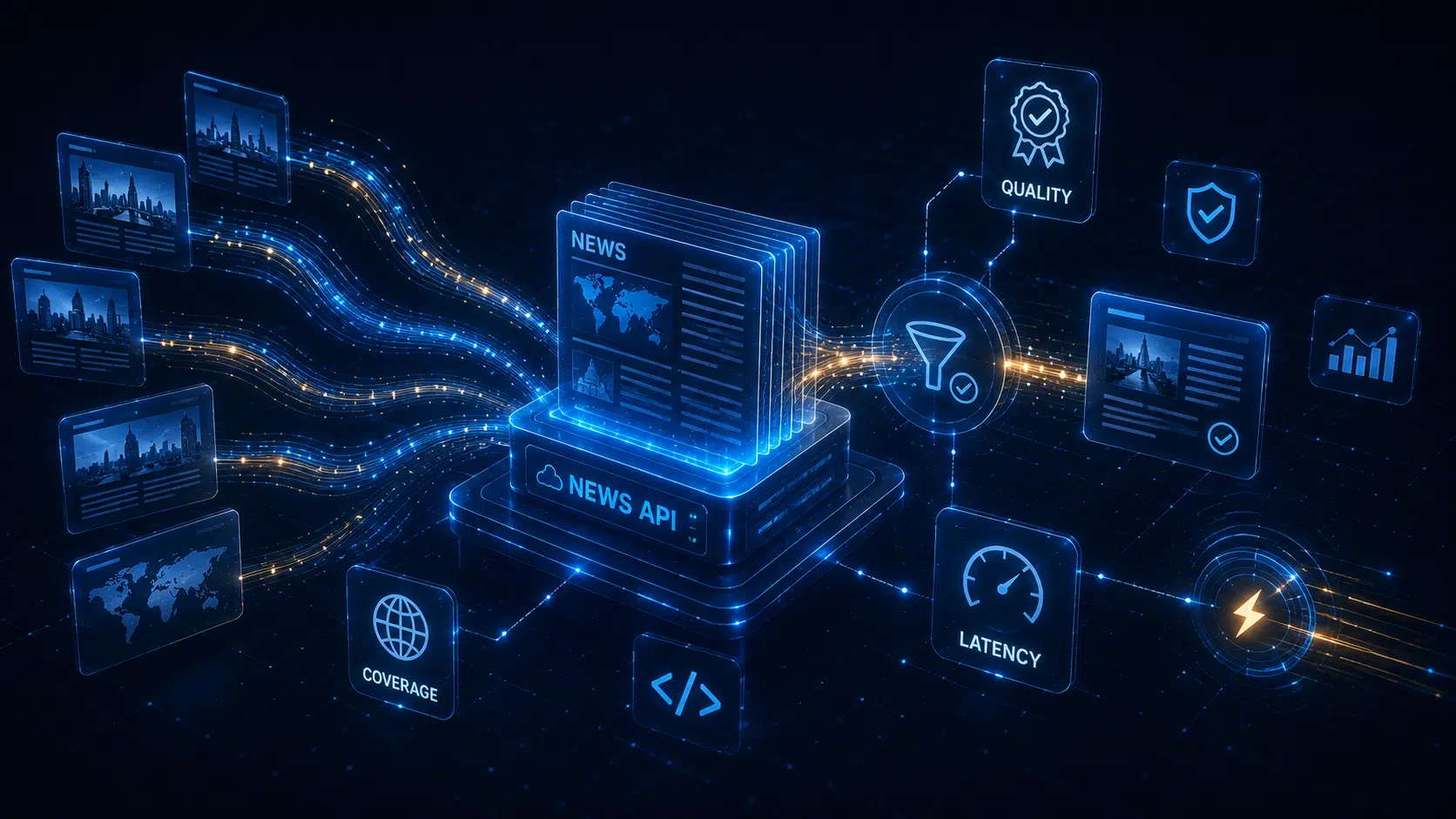
News data has become a core layer of modern business intelligence. Companies use it to monitor markets, track competitors, detect risks, understand public narratives, power AI applications, and identify important events as they unfold. For product teams, data teams, analysts, and developers, the news API behind these workflows is not just a technical integration. It determines how complete, reliable, and timely the intelligence will be.
At Webz.io, we see this every day. Customers come to us because they need more than a simple feed of headlines. They need broad access to global news, structured data they can use at scale, and fast delivery that supports real business decisions. Whether the use case is financial intelligence, media monitoring, risk detection, brand tracking, or AI-powered research, the same three factors usually determine success: coverage, quality, and latency.
These three factors define whether a news API is useful in production. Coverage determines what the API can see. Quality determines whether the data can be trusted and used. Latency determines whether the information arrives while it is still valuable.
Coverage is often the first thing companies look at when evaluating a news API, and rightly so. If the API does not capture the sources, regions, languages, and topics that matter to your business, every product built on top of it will have blind spots.
But coverage is not only about the number of sources. A big source count may sound impressive, but the more important question is whether the coverage matches your actual use case. A financial intelligence platform may need business publications, regulatory updates, local news, and sector-specific sources. A risk intelligence company may need regional media, political news, local incident reporting, and niche publications. A brand monitoring platform may need mainstream media, blogs, product reviews, and international coverage in multiple languages.
This is why the Webz.io News API is built around large-scale access to structured news data from global sources. Many business use cases require more than the most obvious publishers. They depend on the long tail of the open web: local outlets, industry sites, regional publications, blogs, and sources that may not appear in a basic news feed.
Strong coverage helps companies detect signals earlier and understand stories in context. A single headline from a major publication may tell you that something happened. Broader coverage can show where the story started, how it spread, which regions are affected, which companies are mentioned, and how the narrative is evolving.
For customers building AI applications, coverage is even more important. AI systems need enough relevant context to produce useful answers. If the underlying news API misses important sources, the AI output will also miss important facts. Better coverage creates better grounding.
Collecting news is only the first step. Raw web content is messy, duplicated, inconsistent, and difficult to use at scale. Articles are syndicated across many websites. Headlines are rewritten. Pages include ads, navigation text, author bios, unrelated links, and formatting issues. Some articles are updated after publication. Others contain missing metadata or inconsistent timestamps.
This is where data quality becomes critical.
A low-quality news API pushes the cleanup work onto the customer. Developers then need to remove duplicates, normalize fields, clean article text, detect languages, classify topics, extract entities, and build additional logic to separate useful results from noise. That creates hidden costs and slows down product development.
A high-quality news API does more of that work before the data reaches the customer. It delivers structured fields, consistent metadata, reliable filtering, cleaner content, and enrichment that makes the data easier to search, analyze, and integrate.
At Webz.io, this focus on structure and enrichment is central to how we think about news data. A useful news API should do more than return a title and URL. It should help customers understand what the article is about, where it came from, when it was published, which entities appear in it, what language it is written in, and how it can be used inside a larger workflow.
This is especially important for AI and automation. When a human analyst reviews search results, they can often ignore noise and identify what matters. An AI system depends much more heavily on the quality of the retrieved data. If the API returns duplicate, irrelevant, incomplete, or outdated content, the model’s answer will suffer.
Quality also builds trust. Teams need to know the source of each article, the publication date, and the context behind the content. In a world where AI-generated summaries are becoming common, source transparency and clean metadata are not optional. They are part of the credibility of the final product.
News loses value quickly. A story that is highly valuable now may be far less useful tomorrow, or even an hour from now. Latency is the time between the moment an article is published and the moment it becomes available through the API.
For some use cases, latency is a convenience issue. For others, it is a business-critical factor.
Financial platforms need fast access to market-moving news. Risk teams need to identify emerging geopolitical, regulatory, and operational events. Cybersecurity companies need early signs of breaches, leaks, vulnerabilities, and threat activity. Brand monitoring teams need to detect reputational issues before they spread. AI agents that answer questions about current events need fresh information, not stale results.
This is why real-time access is such an important part of the Webz.io News API. Many of our customers are not simply researching what happened in the past. They are building products that need to understand what is happening now.
Latency also affects user trust. When users search for a company, event, executive, product, or crisis, they expect the latest relevant information to appear. If they can already see a story on a publisher’s website but cannot find it through the API, they start questioning the product.
For modern intelligence platforms, freshness is part of the user experience. A news API that is slow may still be useful as an archive, but it will struggle to support real-time monitoring, alerting, and decision-making.
Coverage, quality, and latency are often evaluated separately, but in practice they only create value when they work together.
Coverage without quality creates noise. The API may return a large number of articles, but users still need to deal with duplicates, irrelevant content, missing fields, and inconsistent metadata.
Quality without coverage creates a clean but incomplete view of the world. The results may be structured and easy to use, but important stories may be missing.
Low latency without quality creates fast noise. Delivering bad data quickly does not help teams make better decisions.
Coverage without latency creates an archive. That may be useful for historical research, but it is not enough for monitoring, alerts, risk detection, or AI systems that depend on current information.
The strongest news APIs balance all three. They capture the right sources, transform raw content into structured data, and deliver it quickly enough to support the customer’s workflow.
This is the standard Webz.io is built around. Our goal is not simply to provide access to more articles. It is to help companies turn open web news into structured, timely, and usable intelligence.
AI has changed what companies expect from news data. Large language models can summarize, classify, reason, and generate insights, but they need current external data to understand what is happening now. A news API can provide that grounding layer.
This is especially relevant for retrieval-augmented generation, AI research agents, monitoring products, automated reports, financial intelligence, and risk analysis. The API supplies the facts. The AI turns those facts into summaries, signals, and recommendations.
But AI also raises the bar for data quality. A traditional dashboard can show messy results and let a human filter them. An AI system often turns retrieved content directly into an answer. That means the underlying data must be complete, fresh, structured, and transparent.
If the news API misses important coverage, the AI misses the story. If the API returns poor-quality data, the AI produces weaker output. If the API is slow, the AI gives outdated answers.
This is one reason Webz.io continues to invest in ways to make news content more usable for modern applications. Products such as WebzReporter reflect this broader direction: helping customers access fact-based, structured, and useful information from news content in a way that supports analytics, monitoring, and AI workflows.
For AI-powered products, the news API is not just a content source. It is part of the intelligence engine.
The best way to evaluate a news API is to test it against your real business scenarios. A company monitoring executive mentions should search for its leadership team, competitors, investors, and customers. A financial platform should test public companies, tickers, earnings terms, and market-moving events. A cybersecurity company should test breach terms, ransomware groups, vulnerabilities, leaked credentials, and technical sources. A PR or brand monitoring platform should test brand names, product names, local coverage, and multilingual results.
The goal is not to check whether the API returns something. The goal is to see whether it returns the right things.
When evaluating a provider, look closely at source relevance, freshness, duplicate handling, metadata consistency, filtering options, archive depth, enrichment, and integration experience. Test small companies, local stories, non-English sources, niche topics, and fast-moving events. These tests reveal the real difference between a simple news feed and dependable news data infrastructure.
For teams that want to start experimenting, News API Lite provides a free way for students, developers, and researchers to incorporate news data into non-commercial projects. For commercial and enterprise use cases, the full Webz.io News API is designed for companies that need broader coverage, structured data, and scalable access.
A news API is valuable only when it helps customers make better decisions. That requires more than access to articles. It requires relevant coverage, clean and trustworthy data, and fast delivery.
Coverage decides whether the API sees the world your business cares about. Quality decides whether the data can be used without heavy manual cleanup. Latency decides whether the information arrives in time to act on it.
As more companies build real-time intelligence products and AI-powered workflows, news APIs are becoming a core part of the modern data stack. The winners will not be the providers that simply deliver more content. They will be the providers that deliver the right content, with the right structure, at the right moment.
That is exactly where Webz.io is focused: helping companies turn global news coverage into structured, timely, and actionable intelligence.



Do you use Python? If so, this guide will help you automate supply chain risk reports using AI Chat GPT and our News API.

Use this guide to learn how to easily automate supply chain risk reports with Chat GPT and news data.

A quick guide for developers to automate mergers and acquisitions reports with Python and AI. Learn to fetch data, analyze content, and generate reports automatically.