




How to Automate Supply Chain Risk Reports: A Guide for Developers
Do you use Python? If so, this guide will help you automate supply chain risk reports using AI Chat GPT and our News API.

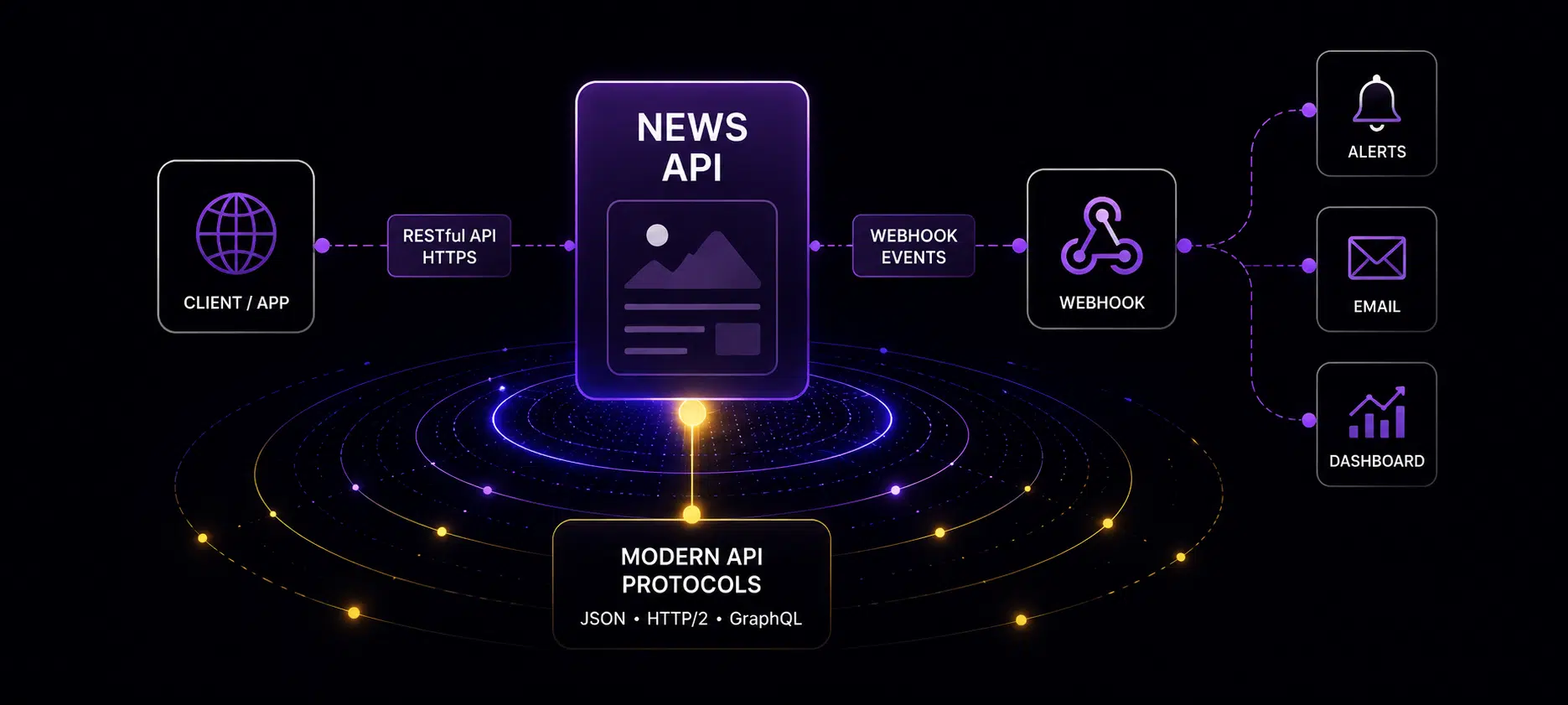
A news API is more than a technical interface. It is the delivery layer between a constantly changing information universe and the systems that depend on it. Financial platforms use news APIs to detect market-moving events. Risk intelligence teams monitor geopolitical developments, sanctions, cyber incidents, and executive changes. Marketing and PR platforms track brand mentions, sentiment, media coverage, and competitor activity. AI systems rely on structured news data to enrich retrieval pipelines, summarize events, and identify emerging narratives.
Because news is time-sensitive, high-volume, multilingual, and context-heavy, the API method matters. A simple REST endpoint can work well for search and historical retrieval. A webhook can deliver breaking news or alerts exactly when a matching event appears. A WebSocket or Server-Sent Events stream can power live dashboards. GraphQL can give product teams precise control over fields and nested entities. gRPC can support high-performance internal pipelines. RSS and Atom feeds still serve lightweight syndication use cases. Each method reflects a different product philosophy around latency, control, scalability, developer experience, and data freshness.
The best news API architecture usually combines several approaches. The question is rarely “Which protocol is best?” The better question is “Which access pattern matches the customer’s workflow?” Search, monitoring, enrichment, alerting, streaming, analytics, and AI ingestion each benefit from a different delivery model.
REST remains the most common pattern for public news APIs because it fits how developers naturally retrieve data from remote systems. REST, originally described by Roy Fielding in his dissertation on Representational State Transfer, centers on resources, representations, stateless interactions, and a uniform interface. In a news API, typical resources include articles, sources, authors, entities, topics, categories, events, and saved searches.
A RESTful news API usually exposes endpoints such as /articles, /sources, /entities, or /search. Clients send HTTP requests with query parameters such as keywords, publication dates, domains, language, country, sentiment, entities, or categories. The API responds with structured JSON containing article metadata, title, body, publication date, source, URL, language, author, image, extracted entities, and sometimes AI-enriched fields such as summaries or topics.
REST works especially well for historical search, pagination, filtering, and data enrichment. A user can ask for all articles mentioning a company over the last 30 days, retrieve coverage from a specific domain, or fetch news in a specific language. REST also fits billing and quota models because each request is measurable, cacheable, and easy to rate-limit.
HTTP semantics, standardized in RFC 9110, give REST APIs a mature foundation. GET retrieves data. POST can create saved searches or submit enrichment requests. Status codes communicate success, invalid parameters, authentication failures, rate limits, and server errors. Headers support authentication, caching, compression, and pagination metadata. This makes REST familiar to developers and easy to integrate across almost every programming language.
For news APIs, REST has one major strategic advantage: it gives the customer control. The client decides when to query, how broad the search should be, and how much data to retrieve. This is ideal for dashboards, research tools, compliance reviews, AI retrieval workflows, and backfills. A customer building a media monitoring archive, for example, can use REST to pull articles from January 2024, then repeat the same query for February, March, and beyond.
The main limitation of REST appears when freshness becomes critical. Polling a REST endpoint every minute for breaking news can create unnecessary load and still miss the immediacy customers expect. REST is excellent for asking, “What exists?” It is less elegant for answering, “Tell me the moment something new happens.”
A REST API becomes much easier to adopt when it is described through a machine-readable contract. The OpenAPI Specification provides a standard way to define HTTP APIs so humans and machines can understand available endpoints, parameters, authentication methods, schemas, and responses.
For a news API provider, OpenAPI is more than documentation. It is a product asset. It allows developers to generate SDKs, test requests, validate responses, create mock servers, and understand the API before writing production code. For large customers, an OpenAPI definition can speed up security reviews, procurement evaluations, and internal integration planning.
In the news API context, OpenAPI is especially useful because query complexity grows quickly. News search endpoints often include date ranges, Boolean operators, source filters, language filters, pagination, sorting, entity filters, deduplication options, and enrichment flags. A clear OpenAPI schema helps customers understand which parameters can be combined and what the response structure will contain.
OpenAPI also strengthens trust. A news API customer needs predictable data contracts. If an article response contains published_at, source.domain, language, entities, and sentiment, those fields should behave consistently across millions of records. A well-maintained OpenAPI specification turns that expectation into a formal interface.
A webhook reverses the traditional API flow. Instead of the customer repeatedly asking the news API for updates, the news API sends an HTTP request to the customer’s endpoint when a relevant event occurs. In practical terms, the customer defines a condition, such as a keyword, company name, risk topic, source list, or entity match. When new matching news appears, the provider pushes the result to the customer.
This model fits news monitoring extremely well. A cyber threat intelligence platform may want an alert when a data breach mentions one of its customers. A financial intelligence platform may want updates when a public company appears in litigation, M&A, executive change, earnings, or regulatory coverage. A brand monitoring platform may want an instant notification when a major outlet publishes an article about a client.
Webhooks are efficient because they reduce polling. They also create a better customer experience for alerting workflows because delivery starts from the event itself. The customer’s system receives a payload, validates its signature, processes the article, and triggers downstream actions such as Slack alerts, dashboard updates, CRM tasks, or case creation.
Strong webhook design requires more than sending JSON to a URL. A professional news API webhook system should include retries, exponential backoff, signed payloads, timestamp validation, delivery logs, idempotency keys, event IDs, and a replay mechanism. News data often has multiple processing stages, so the webhook should clearly distinguish between a newly discovered article, a materially updated article, an enrichment-completed article, and a deleted or corrected record.
Webhooks also benefit from event-driven documentation standards. The AsyncAPI Initiative provides a specification for defining asynchronous APIs, including event-driven architectures. For news API providers, AsyncAPI can describe event types, payload schemas, delivery channels, authentication, and subscriber expectations in a structured way.
The product insight is simple: REST is best for retrieval, while webhooks are best for notification. A mature news API often gives customers both. REST lets them search the full corpus. Webhooks tell them when something important enters it.
WebSocket, defined by RFC 6455, enables two-way communication over a persistent connection. After an opening handshake, the client and server can exchange messages continuously. In a news API, WebSocket delivery is useful when the customer needs a live stream rather than individual alert callbacks.
This model can power real-time news dashboards, trading terminals, emergency response systems, media command centers, and live event monitoring tools. Instead of receiving separate webhook calls or polling a REST endpoint, the client opens a persistent connection and receives a continuous flow of matching news items.
WebSockets are especially relevant when latency matters and the user interface stays open. A newsroom dashboard tracking election updates, a security operations center monitoring cyber incidents, or a market intelligence platform watching ticker-related news can benefit from live streaming. WebSockets also allow clients to send messages back to the server, such as changing filters, subscribing to additional topics, or acknowledging received messages.
The operational tradeoff is complexity. Persistent connections require connection management, authentication renewal, heartbeats, backpressure handling, reconnect logic, and infrastructure that can support many concurrent clients. A webhook can deliver events to a backend system with a simpler request-response lifecycle. A WebSocket stream requires ongoing session management.
For news APIs, WebSockets make the most sense as a premium real-time product layer. They are powerful for interactive applications and live monitoring, while REST and webhooks remain better fits for broad developer adoption and backend automation.
Server-Sent Events, described in the WHATWG HTML Standard, allow a server to push events to a browser or client over HTTP using the EventSource interface. Unlike WebSockets, SSE is one-way: the server sends updates to the client over a persistent connection.
This one-way model aligns naturally with many news use cases. A customer may simply want a live feed of matching articles. The client opens a connection and receives events as they become available. SSE can be easier to implement than WebSockets, especially for browser-based dashboards and live feeds that only need server-to-client updates.
SSE works well for live article feeds, topic streams, status updates, enrichment progress, and alert timelines. A media monitoring dashboard could use SSE to update the interface when new coverage appears. An AI news summarization platform could use SSE to show enrichment progress as articles move through classification, entity extraction, clustering, and summarization.
SSE carries a practical product message: real time does not always require bidirectional communication. When the customer mainly consumes a stream, a simple server-push model can deliver a clean developer experience.
GraphQL gives clients the ability to request exactly the fields they need. The official GraphQL documentation describes a model where clients define the shape of the response through queries, while subscriptions support real-time updates through long-lived operations.
News data often has a deeply connected structure. An article can have a source, author, topics, entities, locations, companies, people, sentiment, categories, related articles, clusters, summaries, quotes, and timeline context. A REST endpoint may either return too much data or require multiple calls to assemble the full picture. GraphQL can solve this by letting the client ask for a precise shape, such as article titles, source names, company entities, sentiment, and related event clusters in one request.
GraphQL is attractive for product teams building rich applications on top of news data. Frontend teams can iterate quickly because they can request the fields their interface needs. Mobile apps can reduce payload size. Complex dashboards can combine article data, source metadata, and entity relationships in a single query.
GraphQL also has a natural fit for knowledge graph-style news products. When news articles are connected to entities, events, industries, geographies, and relationships, GraphQL can expose that graph elegantly. A customer could query a company, retrieve recent negative coverage, inspect related executives, and fetch connected topics.
The tradeoff is governance. News APIs can involve expensive searches across large corpora. GraphQL needs query depth limits, complexity scoring, persisted queries, caching strategies, and careful authorization. A flexible query language can become costly when customers request deeply nested data across high-volume news archives.
GraphQL is therefore best positioned as an application-facing layer for curated, enriched, or indexed news data. REST remains more straightforward for public search APIs, while GraphQL shines when customers need flexible access to structured relationships.
gRPC is a high-performance remote procedure call framework that commonly uses Protocol Buffers for message definitions and HTTP/2 for transport. It supports multiple languages and efficient service-to-service communication.
In the context of news APIs, gRPC is often more relevant behind the scenes than as the main public interface. A large-scale news data platform may have separate services for crawling, parsing, deduplication, language detection, entity extraction, classification, clustering, summarization, indexing, and delivery. These services need fast, strongly typed communication. gRPC is a strong fit for that environment.
For example, a crawler service may send raw documents to a parser service. The parser may send structured articles to an enrichment service. The enrichment service may call an entity recognition service and then pass the result to an indexing pipeline. gRPC can provide efficient contracts between these internal components.
Public gRPC news APIs can make sense for sophisticated enterprise customers that need high-throughput ingestion and can invest in generated clients. A financial data provider, for example, may prefer gRPC for streaming structured market news into low-latency systems. Still, many general developers prefer REST because it is easier to test in a browser, inspect with common tools, and integrate into typical web stacks.
The strongest use of gRPC in news data is usually infrastructure. It helps the provider deliver faster, more reliable, and more consistent downstream APIs, even when the external API remains RESTful.
SOAP, standardized by the World Wide Web Consortium, is an XML-based messaging protocol associated with enterprise web services. It carries a more formal contract style, often using WSDL, and has a long history in banking, government, insurance, telecom, and large enterprise environments.
In modern news APIs, SOAP is rarely the preferred model for new developer products. JSON over HTTP has become the dominant pattern for web APIs because it is lighter and easier for modern developers. Yet SOAP still appears in enterprise environments with established integration standards, strict governance, and legacy middleware.
A news API provider serving government, compliance, legal, or financial institutions may encounter customers whose internal systems still expect SOAP-style integrations. In those cases, SOAP support may function as a compatibility layer rather than the core product interface.
The key insight is that protocol choice can be shaped by the customer’s infrastructure maturity. A startup building an AI media monitoring product may choose REST, webhooks, and GraphQL. A government agency with established XML service buses may still value SOAP compatibility.
OData is an open protocol for creating and consuming queryable RESTful APIs. It standardizes query conventions, filtering, sorting, pagination, metadata, and relationships. It is especially common in Microsoft and SAP ecosystems.
For news APIs, OData can be useful when customers want enterprise-style query consistency. News datasets are highly filterable: date, source, author, language, category, country, entity, sentiment, duplicate group, and topic all matter. OData provides a known pattern for expressing queries across data collections.
An OData-style news API could expose articles as a collection and allow customers to filter by publication date, expand related entities, select specific fields, and sort by relevance or time. This can be attractive for enterprise BI tools, data platforms, and organizations already invested in OData-compatible systems.
OData’s main value is standardization. Rather than inventing custom query parameters for every filter, the provider can adopt a known query grammar. For many developer audiences, a custom REST query syntax may feel simpler. For enterprise customers, OData can feel familiar and governable.
JSON defines conventions for how clients request resources and how servers respond using JSON. It focuses on consistency, relationships, pagination, sparse fieldsets, includes, and predictable response structures.
In news APIs, JSON can help when the data model contains related resources. Articles connect to sources, authors, entities, topics, categories, and clusters. A JSON response can represent those relationships in a standardized format, allowing clients to include related resources and request only selected fields.
This matters because news APIs often evolve from simple article search into richer intelligence platforms. The moment the API includes entity objects, event clusters, source credibility metadata, language variants, and relationship graphs, response consistency becomes important. JSON offers a structured approach that can reduce custom implementation decisions.
Its adoption depends on audience expectations. Many developers are comfortable with plain JSON responses. JSON adds value when consistency, relationship handling, and standardized client behavior matter more than absolute simplicity.
Before modern APIs became the default for developers, web feeds were the standard way to distribute news updates. Atom, standardized in RFC 4287, defines an XML-based format for feeds composed of entries with metadata. RSS and Atom remain useful for lightweight syndication, monitoring, and content distribution.
For news APIs, feeds can serve customers who want a simple stream of updates from a query, source, category, or topic. A customer could subscribe to a feed for “AI regulation,” “cybersecurity breaches,” or “mentions of a company.” Feed readers, automation tools, and internal systems can consume these updates with minimal integration effort.
Feeds are less expressive than modern APIs. They usually provide a simpler payload and fewer query capabilities. However, their simplicity is also their strength. For customers that want syndication rather than deep search, RSS and Atom can still deliver practical value.
A modern news API can use feeds as an entry-level delivery option. REST serves developers. Webhooks serve automation. Streaming serves real-time products. Feeds serve lightweight subscribers.
Some news use cases require massive data transfer rather than request-by-request access. AI teams training models, quantitative researchers analyzing years of coverage, and enterprise data lakes ingesting daily archives may prefer bulk delivery. This often happens through downloadable files, cloud storage buckets, SFTP, or scheduled exports in formats such as JSONL, CSV, Parquet, or compressed archives.
Bulk delivery is technically different from an interactive API, but it belongs in the broader discussion of news data access. A REST API is excellent for targeted retrieval. Bulk files are better for complete datasets, historical archives, and predictable batch processing.
A professional news API provider should think of bulk delivery as a complementary access method. The REST API can help customers explore, test, and retrieve focused data. The bulk pipeline can deliver complete daily archives or historical backfills at scale. Webhooks can notify the customer when a new batch is ready.
This hybrid model matches how serious data customers operate. They use APIs for control and files for volume.
A strong news API strategy starts by mapping protocol choice to customer intent. When customers want to search historical coverage, REST is usually the right foundation. When they want alerts, webhooks create an efficient event-driven workflow. When they want live dashboards, WebSockets or Server-Sent Events provide real-time updates. When they want precise, nested application data, GraphQL can improve flexibility. When they need high-performance internal or enterprise ingestion, gRPC can help. When they operate in legacy enterprise environments, SOAP or OData compatibility can reduce integration friction. When they want simple syndication, RSS and Atom still work. When they need complete archives, bulk delivery is the practical answer.
This is why the most mature news data platforms do not treat API design as a single endpoint decision. They design a delivery portfolio. The same underlying news corpus can be exposed through REST for search, webhooks for alerts, streams for live updates, feeds for syndication, and files for bulk ingestion.
The protocol is part of the product. It shapes who can use the data, how quickly they can integrate it, how much infrastructure they need, and how naturally the API fits their workflow.
Every API method needs a trust layer. News data can be commercially sensitive, licensed, rate-limited, and customer-specific. REST APIs commonly use API keys, OAuth 2.0, or signed requests. Webhooks should use signed payloads and timestamp validation. WebSocket and SSE connections need secure token-based authentication and reconnect handling. Bulk delivery needs controlled access to storage locations and audit logs.
Rate limits also need to match the method. REST rate limits can be measured per request, per endpoint, or per returned article. Webhooks may be governed by event volume and delivery retries. Streaming APIs may use concurrent connection limits, message throughput limits, or topic subscription limits. Bulk exports may be governed by dataset size, refresh frequency, and retention period.
Reliability matters because news workflows often support business-critical decisions. A missed alert can affect risk monitoring. A delayed article can reduce product value. A duplicated item can pollute analytics. Good news API design includes idempotency, stable article IDs, deduplication logic, retry handling, delivery receipts, pagination stability, and clear data freshness indicators.
The best providers also expose operational transparency. Status pages, delivery logs, webhook replay tools, schema versioning, changelogs, and clear deprecation policies help customers build confidence in the API.
Protocol choice gets attention, but schema design determines long-term usability. A news API should represent articles consistently across sources, languages, and formats. At minimum, customers expect a title, body or summary, URL, source, publication time, discovery time, author when available, language, country, and metadata. Advanced APIs add entities, sentiment, categories, topics, duplicate groups, event clusters, source rankings, paywall indicators, media type, and AI-generated enrichments.
The schema should distinguish between facts from the publisher and enrichments generated by the API provider. For example, the article title and published date may come from the source, while entity extraction, sentiment, category, and summary may come from downstream processing. This distinction helps customers evaluate trust, explain outputs, and debug edge cases.
Versioning is crucial. News APIs evolve as providers add fields, improve enrichment models, expand languages, and introduce new source types. Backward-compatible changes should be easy to adopt, while breaking changes should follow a clear versioning strategy. REST can use URL versions or header-based versions. Webhooks should include event schema versions. GraphQL can use deprecation metadata. Bulk files should include schema manifests.
For AI-driven news applications, schema clarity becomes even more important. Retrieval-augmented generation systems need stable IDs, timestamps, source attribution, language metadata, and clean article text. Risk systems need entity normalization and event classification. Media intelligence systems need deduplication and source context. The API protocol delivers the data, but the schema determines whether the data is useful.
The future of news APIs will be hybrid. REST will continue to dominate search and retrieval because it is universal, simple, and effective. Webhooks and streaming interfaces will become more important as customers expect real-time monitoring. GraphQL will grow where news data becomes more relational and product teams need flexible access. gRPC will continue to support high-performance internal systems and specialized enterprise ingestion. Bulk delivery will remain essential for AI, analytics, and data lake use cases.
AI is also changing what customers expect from news APIs. They increasingly want more than raw articles. They want extracted facts, summaries, entities, events, risk signals, company mentions, topic clusters, and structured outputs suitable for machine reasoning. This increases the importance of API methods that can support both discovery and workflow automation.
A strong AI-ready news API should let customers search the archive, subscribe to new matching content, stream urgent updates, retrieve enriched article objects, and export large datasets. It should also provide transparent metadata around source, freshness, enrichment type, and confidence. The API should make news computable, explainable, and operationally useful.
RESTful APIs, webhooks, WebSockets, Server-Sent Events, GraphQL, gRPC, OData, SOAP, JSON, RSS, Atom, and bulk delivery all have a place in the news API landscape. Each method represents a different relationship between the provider, the customer, and the flow of information.
REST gives customers control over search and retrieval. Webhooks deliver timely alerts. WebSockets and SSE power live experiences. GraphQL exposes complex relationships with precision. gRPC improves performance in demanding systems. OData and SOAP support enterprise compatibility. JSON creates consistency for resource-oriented data. RSS and Atom keep syndication simple. Bulk delivery handles scale.
The most effective news API strategy uses the right method for the right workflow. News moves fast, but customers consume it in different ways. A professional API design recognizes those differences and turns them into clear, reliable, developer-friendly access patterns.



Do you use Python? If so, this guide will help you automate supply chain risk reports using AI Chat GPT and our News API.

Use this guide to learn how to easily automate supply chain risk reports with Chat GPT and news data.

A quick guide for developers to automate mergers and acquisitions reports with Python and AI. Learn to fetch data, analyze content, and generate reports automatically.